
Hill Starts Demystified: Mastering Sydney’s Steepest Streets
Ask a learner in Sydney’s South Eastern Suburbs what worries them most and hill starts come up again and again. Rolling back toward the car behind is one of those fears that grows every time it is avoided. A hill start driving lesson in Sydney solves it faster than months of avoidance, because the technique is short, learnable and almost entirely mechanical.
There is very little talent involved. There is a sequence, and once it is habit, the hill stops mattering. Driven to Drive has spent more than 11 years teaching learners across Mascot, Botany, Rosebery, Eastlakes, Maroubra, Randwick and Bondi, and hill starts are one of the skills that most reliably transforms a nervous learner into a confident one.
Why do hill starts feel so hard?
Because two things happen at once that normally happen separately. On flat ground, releasing the brake and applying the accelerator are sequential and forgiving. On a gradient, gravity fills the gap between the two. Any delay becomes backward movement, and backward movement toward a vehicle behind produces panic, which produces a rushed accelerator input, which produces a stall or a lurch.
The technique works by removing the gap.
The rules that apply before the technique
Learner drivers in NSW must display L plates clearly on the front and back of the vehicle, must not exceed 90 km/h, must have zero alcohol in their system, and must not use a mobile phone at all while driving, including hands-free. The supervising driver must hold a full Australian driver licence. Learners under 25 must complete at least 120 hours of supervised driving, including at least 20 hours at night. See using your learner driver log book.
On a hill specifically, the relevant road rule is straightforward: you must not roll back into the vehicle behind you. Distance from the vehicle in front matters too. Leave enough room that a small roll, yours or theirs, does not become contact.
Hill starts in an automatic
Most learners today are in automatics, and the technique is simpler than the reputation suggests.
- Stop with the foot brake, holding firmly. Leave a sensible gap to the vehicle ahead, roughly enough to see their rear tyres touching the road.
- Keep the vehicle in Drive.
- When it is time to move, move your right foot from the brake to the accelerator smoothly and without pause. On a gentle gradient the car’s creep will hold you briefly. On a steeper one, expect a very slight roll and cover it by applying gentle accelerator immediately.
- If the gradient is steep enough that a roll is unavoidable, use the handbrake or electric park brake. Hold the brake, apply the park brake, move your foot to the accelerator, build light pressure, then release the park brake as the car takes up drive.
Many modern cars have hill start assist that holds the brake for a moment after your foot lifts. It is a useful aid, but you should learn the technique that works without it, because you will not always drive that car.
Hill starts in a manual
The manual version is where the clutch does the work, and where the concept of the biting point becomes real.
- Stop, foot brake on, clutch in, select first gear.
- Apply the handbrake and keep it on.
- Bring the clutch up slowly to the biting point. You will feel the car settle, the nose lift slightly, and the engine note change. Hold it there.
- Add light accelerator, enough to hold the revs steady rather than to rush the car.
- Release the handbrake smoothly. The car will move forward. Continue easing the clutch up as you go.
The single most common error is releasing the handbrake before the clutch reaches the biting point. The fix is patience: find the bite first, every time, and let the sequence be slow while it is being learned.
Four scenarios from Sydney roads
Stopped on a steep street with a car close behind
The pressure is social as much as mechanical. Use the handbrake method, which removes rollback entirely. Take the extra second. A slow, controlled start is better in every respect than a rushed one, and the driver behind would far rather wait than be hit.
A hill start at a busy intersection in Maroubra or Randwick
Here the challenge is combining the hill start with observation. Complete the sequence first, then move, then observe as you go. Get the mechanics automatic on quiet streets first so that on a busy road your attention is free for the traffic.
Stop-start traffic on an incline
Repeated hill starts in a queue are exhausting if every one is a separate crisis. Increase your gap to the car ahead so you can move in one continuous roll rather than starting from a dead stop each time.
The car rolls back further than expected
Do not panic-accelerate. Reapply the foot brake firmly, stop, reset, and start again using the handbrake method. A calm reset is safe. A sudden burst of accelerator is not.
Common mistakes and how to avoid them
- Releasing the handbrake too early in a manual. Find the biting point first.
- Revving hard to compensate. It causes wheelspin and lurching, not control.
- Stopping too close to the vehicle ahead, which removes all margin.
- Avoiding hills entirely during practice, so the first real hill start happens under pressure.
- Relying on hill start assist without understanding the underlying technique.
- Forgetting to observe once the car starts moving, because all the attention went into the start itself.
The Safer Drivers Course
For learners under 25 working toward their Ps, the Safer Drivers Course builds hazard awareness and risk perception, encourages safe decision-making and handling distractions, and contributes 20 logbook hours toward the 120-hour requirement.
Andrew is a certified Safer Drivers Course facilitator and delivers the course in a structured, safe and supportive environment.
Recognising the technique is knowledge. Staying calm while a queue builds behind you is judgement, and judgement is what the course develops.
Penalties and demerit points
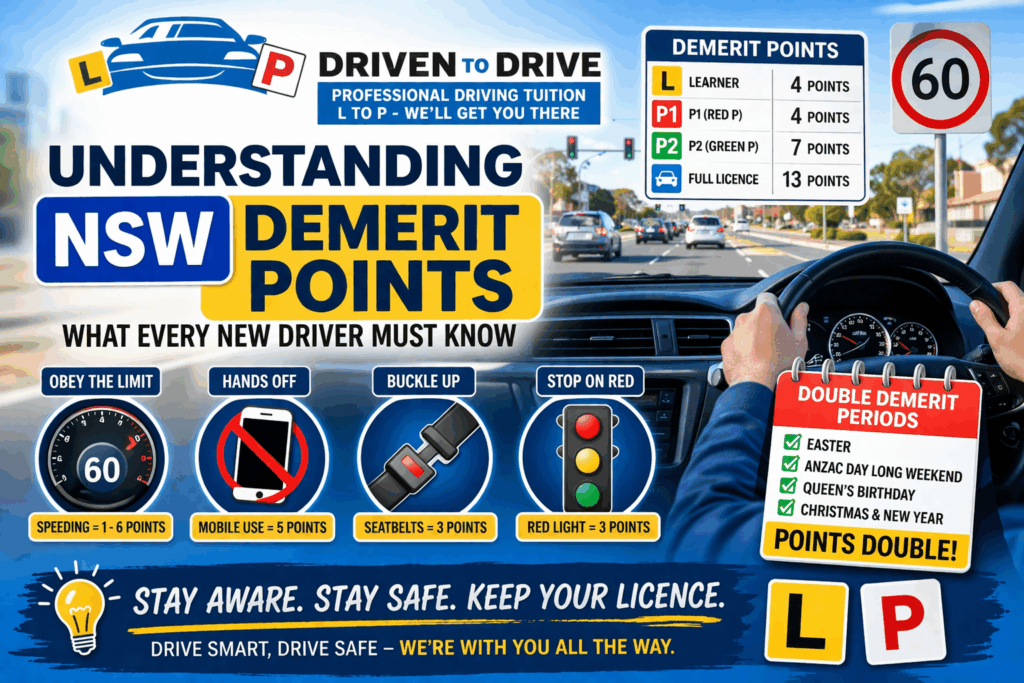
NSW learners hold only 4 demerit points, and exceeding this results in a minimum three-month suspension. P1 drivers are also on 4 points, P2 drivers on 7. Specific fine amounts are not listed here, because penalties vary by offence and severity. Refer to Service NSW and how demerit points work for current details.
Tips from Andrew
- Learn hill starts on a quiet street before you need them on a busy one. Choose the gradient deliberately.
- In a manual, find the biting point ten times in a row on the flat before you take it to a hill.
- Leave more gap than feels necessary on an incline. Space is what turns a mistake into a non-event.
- Practise calm resets. Knowing you can safely stop and start again removes most of the fear.
- Plan turns and merges early, and treat a hill start the same way: decide before you need to act.
Frequently asked questions
How do you do a hill start without rolling back?
Use the handbrake. Hold the foot brake, apply the handbrake, move to the accelerator and in a manual find the clutch biting point, then release the handbrake as the car takes up drive. This removes rollback almost entirely.
Are hill starts harder in a manual or an automatic?
Manual hill starts require more coordination because of the clutch, but the handbrake method makes both manageable. Automatics are easier on gentle gradients where the car’s creep holds you briefly.
Does hill start assist mean I do not need the technique?
No. Hill start assist holds the brake momentarily and is a useful aid, but you should learn the underlying technique so you are competent in any vehicle.
Where can I practise hill starts in Sydney’s South Eastern Suburbs?
Your instructor will select quiet residential gradients first and build toward busier intersections as your confidence grows. The progression matters more than the specific street.
Does the Safer Drivers Course help with confidence on hills?
Indirectly, yes. It builds hazard awareness and decision-making under pressure, which is the part of a hill start that usually goes wrong, and it contributes 20 logbook hours toward the 120-hour requirement.
Ready to become a safe, confident driver?
Book your lessons with Driven to Drive, South Eastern Sydney’s trusted driving school for over 11 years. Or join our Safer Drivers Course in Mascot and earn 20 logbook hours while learning the skills to drive safely for life.
Government references
This blog provides general driving information only. Always refer to official NSW Government sources for the latest rules, penalties and licensing requirements.
| Ready to Build Your Confidence Behind the Wheel?
The first solo drive is a mental milestone as much as a practical one — and preparation is everything. At Driven to Drive, we have helped hundreds of Sydney learners transition from L plates to P plates with calm, expert-guided instruction across Mascot, Botany, Rosebery, Eastlakes, Maroubra, Randwick, Bondi, and the South Eastern Suburbs. Whether you are still logging hours, preparing for your driving test, or looking for P-plate coaching after you have passed — Andrew and the Driven to Drive team are here to help you drive safely for life. 📞 0416 321 572 📧 driventodrive@outlook.com 🌐 driventodrive.com.au Book your lesson today — and let’s make every drive a confident one. |
| Disclaimer: This blog provides general driving information only. Always refer to official NSW Government sources for the latest road rules, penalties, and licensing requirements. Driven to Drive recommends consulting Service NSW (service.nsw.gov.au) and Transport for NSW (transport.nsw.gov.au) directly for all current licence conditions. |