
Introduction
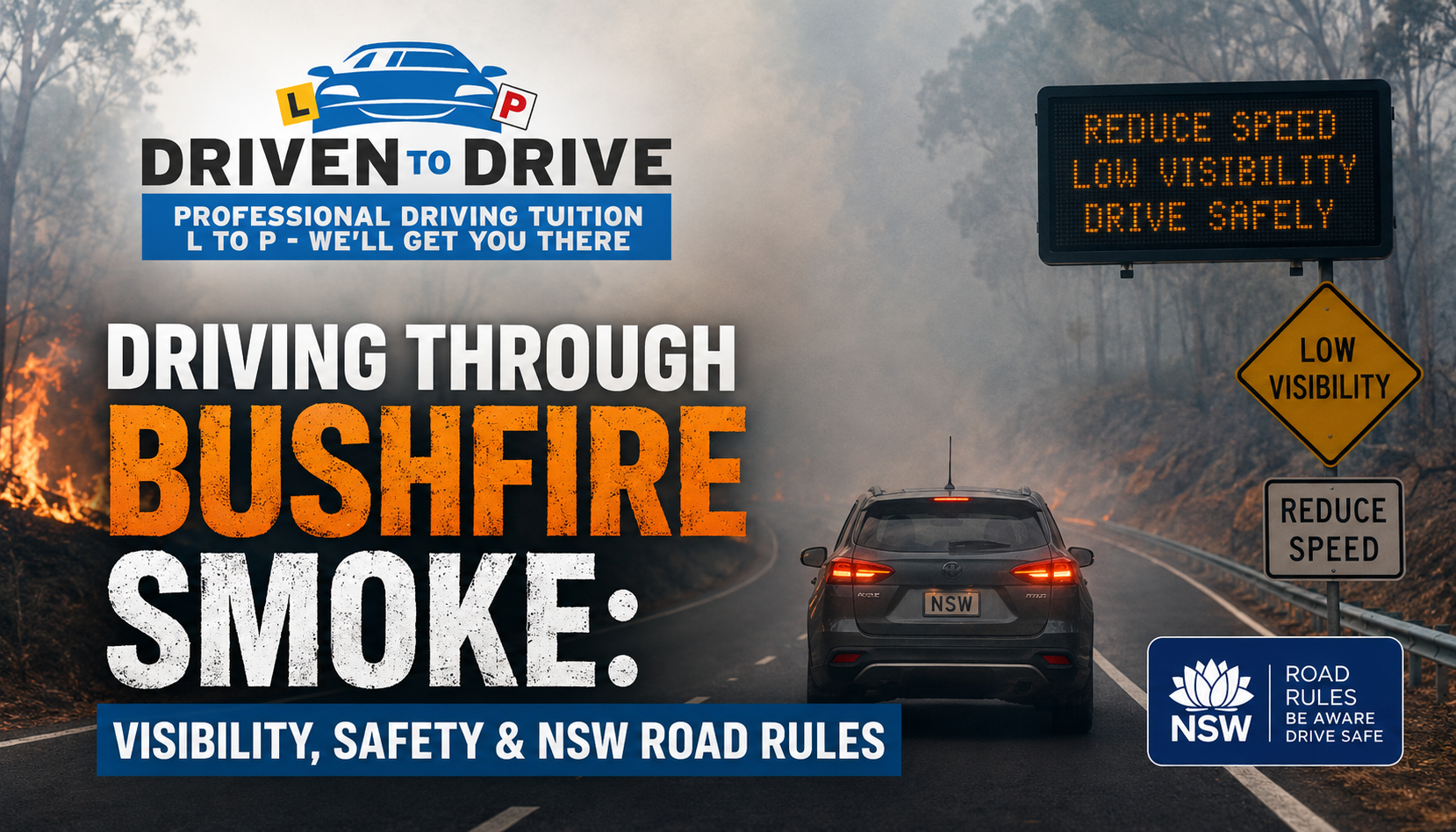
During the 2019–20 bushfire season, air quality in Sydney fell to hazardous levels for days at a time. The NSW Department of Planning, Industry and Environment recorded PM2.5 readings that far exceeded safe thresholds, and at its worst, visibility across parts of greater Sydney dropped to less than one kilometre. Roads that drivers travel every day — familiar routes through Mascot, Maroubra, Randwick, and the Eastern Suburbs — became genuinely dangerous environments.
Most drivers associate reduced-visibility hazards with rain, fog, or night-time driving. Bushfire smoke, however, is different: it can appear with little warning, affect densely populated urban areas far from any fire zone, and create conditions as treacherous as heavy fog with none of the built-in caution that rain typically triggers. Many drivers are caught off guard precisely because the air looks hazy rather than opaque — and underestimate how severely their sight lines and reaction time are being compromised.
This guide is written for all NSW drivers, with specific advice for learner drivers completing their 120 logbook hours. At Driven to Drive Driving School — based in Mascot and serving the South Eastern Suburbs of Sydney for over 11 years — hazard awareness in all weather and environmental conditions is a core part of every lesson. Andrew, our certified Safer Drivers Course Facilitator, teaches learners not just how to control a vehicle, but how to read road conditions and make calm, safe decisions when conditions change unexpectedly. That includes bushfire smoke.
How Bushfire Smoke Affects Driving Conditions
Bushfire smoke is not simply reduced visibility — it creates a compound set of hazards that interact with one another in ways that amplify risk:
- Visibility can drop dramatically and without warning — even in inner Sydney, 30 kilometres from the nearest fire zone. A wind shift can bring heavy smoke into urban streets within minutes.
- Smoke affects depth perception. Drivers may misjudge the distance to the vehicle ahead, to an intersection, or to a pedestrian crossing — particularly in conditions where contrast is reduced.
- Eyes water, sting, and lose focus in smoke. Prolonged exposure while driving leads to involuntary blinking, tearing, and temporary blurring of vision.
- Cognitive distraction and anxiety increase. The smell of smoke and the altered appearance of the environment create a stress response in many drivers — affecting concentration and decision-making.
- Ash fall and debris on road surfaces can reduce traction, particularly on curves, roundabouts, and in wet conditions. Roads that appear dry may have a thin layer of ash acting as a lubricant.
Taken together, these factors mean that smoke-affected roads require the same mindset as driving in fog — or worse. Learner drivers and experienced motorists alike must adjust their approach accordingly.
NSW Road Rules for Driving in Reduced Visibility
NSW road rules set clear obligations for drivers in low-visibility conditions. The following rules are drawn directly from the Road Rules 2014 (NSW) and Transport for NSW guidance:
| ⚠️ KEY NSW RULES — Reduced Visibility Conditions
Headlights: You must use headlights when visibility is less than 200 metres (Road Rules 2014, Rule 116). This applies during the day as well as at night. Speed: You must drive at a speed that allows you to stop safely within the distance you can see ahead. Exceeding this — even within the posted speed limit — is a breach of your duty to drive safely. Hazard lights while moving: Do NOT use hazard lights while your vehicle is in motion. This is prohibited under NSW Road Rules and causes confusion for other drivers about your direction and braking intention. Pulling over: If conditions are dangerously poor, you may pull off the road completely to a safe location and wait. Do not stop on the road itself. Emergency directions: Always follow directions from NSW Police, Fire and Rescue NSW, or Roads and Maritime Services officers — even if those directions differ from standard road rules. |
For the most current rule references, visit the NSW Road User Handbook (Transport for NSW) and Service NSW. Always refer to official sources for any recent amendments.
What to Do Before You Drive in Smoke Conditions
Preparation before you turn the ignition is one of the most effective risk-management tools available to any driver. In smoke-affected conditions, consider the following steps:
- Check the NSW Rural Fire Service ‘Fires Near Me’ app (rfs.nsw.gov.au) and the Bureau of Meteorology (bom.gov.au) for fire locations, wind forecasts, and predicted smoke movement before you leave.
- Review your route. Is it in or near a declared fire zone or active burn-off area? Are there alternative routes that pass through less affected areas?
- Inspect your vehicle’s lights. Ensure headlights, tail lights, brake lights, and indicators are all functioning correctly. Other drivers will rely on your lights to detect your position.
- Set your air conditioning to recirculate cabin air before you enter a smoke-affected zone. This significantly reduces the volume of particulates entering the vehicle.
- Charge your phone and ensure someone knows your planned route and estimated arrival time.
- Consider postponing the trip entirely if conditions are forecast to worsen significantly. No journey is worth the risk of driving in near-zero visibility.
For learner drivers: supervising drivers should assess conditions before any planned practice session and reschedule without hesitation if there is any smoke-related concern. Andrew and the team at Driven to Drive would rather reschedule a lesson than put a learner at unnecessary risk.
Real-World Scenarios: Smoke on Sydney Roads
The following scenarios reflect situations that NSW drivers — including learners in the South Eastern Suburbs — may actually face during bushfire season.
| Scenario 1: Smoke rolls in on Eastern Distributor near Mascot
Situation: You are driving northbound on the Eastern Distributor in the afternoon. Wind conditions change and a heavy smoke front moves across the road. Visibility drops from clear to approximately 80–100 metres within 60 seconds. NSW Rule: NSW Road Rules 2014, Rule 116: Headlights must be on when visibility is less than 200 metres. You must also reduce speed to allow stopping within the visible distance ahead. What to do:
|
| Scenario 2: Ash and smoke haze on a Randwick roundabout
Situation: You are approaching a roundabout in Randwick during light smoke haze. The road surface has a thin layer of ash from overnight burns. It has not rained recently. NSW Rule: NSW Road Rules 2014 require you to give way to vehicles already in the roundabout and to drive at a safe speed. Reduced surface friction from ash is a road hazard requiring adjusted technique. What to do:
|
| Scenario 3: Sudden visibility drop on Maroubra Road — deciding to pull over
Situation: You are driving along Maroubra Road when visibility drops suddenly to less than 50 metres due to a fast-moving smoke front. You can barely see the tail lights of the vehicle in front. NSW Rule: NSW Road Rules permit — and common sense demands — that you pull off the road completely when continuing would be unsafe. Stopping on the roadway itself is dangerous. What to do:
|
| Scenario 4: Managing anxiety from an impatient driver behind you
Situation: You are driving cautiously through smoke haze — correctly, at a reduced speed — and the driver behind you is tailgating and appears impatient. NSW Rule: NSW road rules do not permit other road users to pressure you into unsafe behaviour. You are legally and morally correct to maintain a safe speed in reduced-visibility conditions. What to do:
|
| Scenario 5: Learner driver completing logbook hours during smoke conditions
Situation: A learner driver is mid-session with their supervising driver when smoke haze thickens unexpectedly. The learner is nervous and unsure whether to continue. NSW Rule: Learner drivers are not required to drive in conditions that are unsafe or that exceed their current skill level. The supervising driver has a duty of care to the learner. What to do:
|
Common Mistakes Drivers Make in Smoke Conditions
The following errors are observed frequently in low-visibility conditions. Understanding them — and correcting them — can mean the difference between a safe journey and a collision.
- Not turning headlights on during the day. Many drivers rely on DRLs, which typically do not activate tail lights. In smoke, other drivers cannot see the rear of your vehicle unless full headlights are on.
Correction: Switch to full headlights the moment visibility falls or haze begins — not once it has already become dangerous.
- Maintaining normal following distance. Three seconds is a minimum under clear conditions; it is insufficient when sight lines are shortened by smoke.
Correction: Extend to at least four seconds in light haze, five or more in heavy smoke.
- Using hazard lights while driving. Some drivers activate hazard lights in poor visibility thinking it helps. It is illegal in NSW when the vehicle is moving and actively dangerous — other drivers cannot tell whether you are turning left, turning right, or braking.
Correction: Headlights and brake lights provide sufficient indication. Reserve hazard lights for when you are stationary or broken down.
- Stopping on the road surface. When visibility drops suddenly, some drivers stop where they are rather than pulling completely off the road.
Correction: Always move fully off the road before stopping. A vehicle stopped in a lane is invisible to approaching traffic in heavy smoke.
- Driving at the speed limit regardless of conditions. The posted speed limit assumes normal visibility and road conditions. In smoke, it may be far too fast to stop within your visible distance.
Correction: Reduce speed to match conditions, not to match the sign. This is both legally required and basic common sense.
The Safer Drivers Course: Hazard Awareness for Real Conditions
The NSW Safer Drivers Course is an evidence-based program developed for learner drivers who have completed at least 50 logbook hours. It is specifically designed to build the hazard perception, risk judgement, and calm decision-making skills that standard driving practice alone does not always develop.
Completing the course earns learners 20 bonus logbook hours toward the mandatory 120-hour requirement — a significant practical benefit. More importantly, it equips learner drivers with a framework for reading and responding to hazardous conditions, including:
- Identifying developing hazards before they become emergencies
- Managing distraction and cognitive load while driving
- Making safe decisions under time pressure and in unfamiliar conditions
- Understanding risk and personal vulnerability as a new driver
For Sydney learners in areas such as Mascot, Maroubra, Botany, and Eastlakes, these skills are directly relevant to navigating real conditions — including smoke, rain, night-time driving, and heavy traffic.
Andrew, Driven to Drive’s instructor and certified Safer Drivers Course Facilitator, delivers the course in a structured, supportive environment. His 11+ years of teaching experience in NSW means the course content is grounded in local road conditions — not generic theory. Parents and learners can book directly through Driven to Drive.
| ✅ Safer Drivers Course — Key Facts
Eligible: Learner drivers who have completed 50+ logbook hours Duration: Approx. 6 hours (facilitated group sessions + on-road module) Logbook credit: 20 bonus hours toward the 120-hour requirement Delivered by: Andrew — certified NSW Safer Drivers Course Facilitator Booking: driventodrive.com.au | 0416 321 572 |
Penalties and Demerit Points: What Learner Drivers Must Know
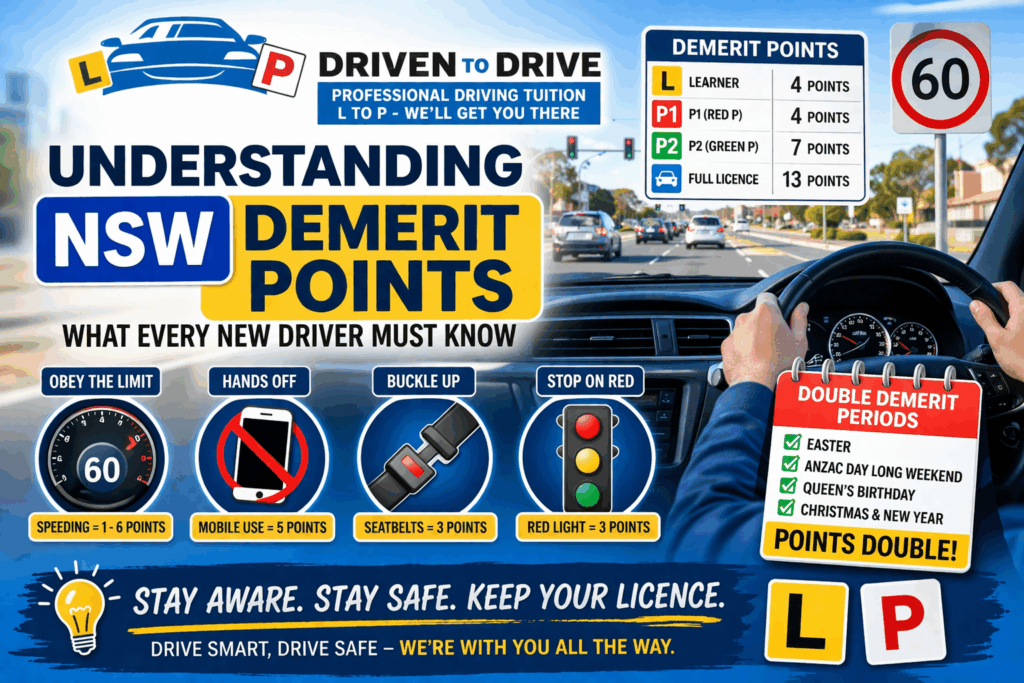
NSW learner drivers hold a maximum of four demerit points. Exceeding this total — through any combination of offences during the learner licence period — results in a minimum three-month licence suspension. For learners working toward their P1 licence, any suspension resets significant progress.
Offences that are particularly relevant in smoke-affected or reduced-visibility conditions include:
- Driving without headlights when required
- Failing to drive at a safe speed for the conditions
- Improper use of hazard lights while moving
- Stopping or parking in a hazardous location
Penalties vary by offence type and severity. Do not rely on unofficial sources for fine amounts or demerit points — these can change. Always check with Service NSW (service.nsw.gov.au) for current information.
Expert Tips from Driven to Drive Instructors
The following advice reflects the teaching approach Andrew uses at Driven to Drive — calm, practical, and grounded in NSW road conditions:
- Check conditions before you leave, not after you have started driving. The Fires Near Me app and Bureau of Meteorology give you the information to make a good decision at home rather than on the road.
- Treat smoke like fog. If you would not drive through heavy fog at the speed limit without headlights and extended following distance — and you should not — apply the same logic to smoke.
- Turn headlights on early. Not when visibility has already dropped — when it starts to drop. The purpose is to make yourself visible to others, not just to see better yourself.
- Narrate your hazard awareness aloud during learner sessions. For supervising drivers, talking through what you are seeing (‘that smoke is thickening — I am going to slow down now’) builds the learner’s hazard perception in real time.
- Know when to stop. The decision to pull off the road safely is a driving skill, not a defeat. Practise it. Recognising when conditions exceed safe operating limits — and acting on that recognition — is one of the highest-value skills a driver can have.
Official NSW Government References
All road rules and licensing information in this blog are drawn from the following official sources. Always consult these directly for the most current requirements:
- Transport for NSW — Learner Driver Resources
- Service NSW — Getting Your P1 Licence
- NSW Road User Handbook (PDF)
- NSW Safer Drivers Course — Official Information
- NSW Rural Fire Service — Fires Near Me
- Bureau of Meteorology — NSW Forecasts
- NSW Centre for Road Safety
Ready to Drive Safely in Any Condition?
| Book your lessons with Driven to Drive — South Eastern Sydney’s trusted driving school for over 11 years.
Join our Safer Drivers Course in Mascot and earn 20 logbook hours while learning the hazard awareness skills to drive safely for life — in sunshine, rain, or bushfire smoke. 📞 0416 321 572 ✉️ driventodrive@outlook.com 🌐 driventodrive.com.au |
Related reading on the Driven to Drive blog:
- Weather Driving: Rain, Wind and Wet Roads in NSW
- Defensive Driving: Building Lifelong Safe Habits
- Night Driving Mastery: A Learner’s Complete Guide
Disclaimer
This blog provides general driving information for educational purposes only. It is not legal advice. Road rules and penalties may change. Always refer to official NSW Government sources — including Transport for NSW, Service NSW, and the NSW Centre for Road Safety — for the most current and authoritative information. All content should undergo human review by a qualified road safety expert before final publication. Driven to Drive Driving School accepts no liability for decisions made based on information contained in this post.