
Introduction
Every second counts when an ambulance is responding to a cardiac arrest or a fire engine is racing toward a burning building. The actions of every driver on the road between that vehicle and its destination can mean the difference between life and death.
For learner drivers in particular, encountering an emergency vehicle with flashing lights and sirens for the first time can be overwhelming. The instinct to react quickly — swerving, stopping suddenly, or even running a red light — can itself cause accidents. Knowing the law, and practising the right response in advance, is what keeps everyone safe.
At Driven to Drive, we’ve spent more than 11 years teaching drivers across Mascot, Randwick, Maroubra, and Sydney’s South Eastern Suburbs to handle exactly these situations with calm and confidence. In this guide, we’ll walk through every NSW rule that applies when an emergency vehicle is present — and how to respond correctly every single time.
NSW Law: What You Must Do for Emergency Vehicles
Under the NSW Road Rules 2014 (Rules 78–79), all drivers have clear legal obligations when an emergency vehicle is present. These rules apply to any vehicle displaying flashing blue or red lights, or sounding a siren — including police cars, ambulances, and fire trucks.
Emergency Vehicle Road Rules at a Glance
Source: NSW Road Rules 2014, Rules 78–79 and Rule 126. Transport for NSW (transport.nsw.gov.au) |
Penalties apply for failing to give way to an emergency vehicle. These are serious offences under NSW law — always refer to Service NSW for current fine amounts and demerit point values, which may change.
The NSW Move Over Law
A separate but equally important rule applies when an emergency or assistance vehicle is stationary on the side of the road with its lights flashing. This is commonly known as the ‘Move Over Law,’ and it covers a broader range of vehicles than many drivers realise.
Move Over Law — What You Must Do
Source: Transport for NSW — Road Users. NSW Road Rules 2014 (transport.nsw.gov.au) |
A common situation: you’re driving along Anzac Parade in Randwick (posted at 60 km/h — well within the ≤ 80 km/h threshold) when you see a police car pulled to the side with lights flashing during a roadside stop. In this case, you must slow to 40 km/h and, if the road has multiple lanes, shift to the lane furthest from the police car. This applies because the speed limit is 80 km/h or below. On a motorway or expressway with a 90 km/h+ limit, the requirement would be to slow to a safe and reasonable speed and change lanes if safe — not specifically 40 km/h.
How to Respond When You Hear a Siren
The biggest danger when a siren is heard is panic. A sudden, instinctive reaction — swerving without checking mirrors, braking without warning — can cause the very accident you are trying to avoid. The correct response is calm, deliberate, and sequential.
- Stay calm and listen. Don’t react immediately. Identify where the sound is coming from — in front, behind, or from a side street. Sirens can echo and mislead. Give yourself a second to assess.
- Check all mirrors. Identify the vehicle type and its direction of travel. Check that the driver behind you has also noticed the siren before you take action. Sudden braking without warning can cause a rear collision.
- Indicate and move left safely. Activate your left indicator, check your mirrors and blind spot, then move gradually to the left side of your lane or into the left lane. Stop near the kerb when safe.
- Stay stopped until the vehicle has fully passed. Do not move off while the vehicle is still passing or approaching. Remain stationary with your indicator still active until the emergency vehicle has completely cleared the intersection or your position.
- At red lights — move left and hold your position unless entirely safe. Move as far left as possible within the intersection space. Under Rule 78(3), NSW law technically permits crossing a stop line to clear the path if it is entirely safe — but road authorities and instructors strongly advise against it unless absolutely necessary. Never enter an intersection blindly against cross-traffic. When in doubt, hold your position and allow the emergency vehicle to navigate around you.
- Resume driving carefully. Once the emergency vehicle has passed and it is safe, check your mirrors before pulling back into traffic. Be aware that a second emergency vehicle may follow — remain alert for 30–60 seconds afterwards.
Real-World Scenarios: Applying the Rules
Here are three situations learner drivers in Sydney’s South Eastern Suburbs are likely to encounter, and how to handle them correctly.
| 🚨 Scenario: Ambulance approaching from behind on a two-lane road near Maroubra
NSW Rule: NSW Road Rules 2014, Rule 78 — Give way to emergency vehicles.
|
| 🚨 Scenario: Fire truck approaching at a busy intersection in Mascot
NSW Rule: NSW Road Rules 2014, Rule 78 — You must give way even if you have a green light.
|
| 🚨 Scenario: Police car stationary on the shoulder of Southern Cross Drive (90 km/h zone)
NSW Rule: NSW Move Over Law — On roads 90 km/h or above, change lanes and slow to a safe and reasonable speed.
|
Common Mistakes Drivers Make — and How to Avoid Them
⚠️ Mistakes That Put Lives at Risk
|
Driving Near Emergency Scenes
When you approach an accident scene or active emergency, different rules apply — and additional care is essential.
- Do not slow down to look. Slowing to observe an accident (sometimes called rubber-necking) is a known cause of secondary crashes. Keep your eyes on the road ahead and maintain an appropriate following distance.
- Follow police direction. Police officers directing traffic at an accident scene have the legal authority to override road markings, traffic lights, and posted signs. Their directions take precedence. Obey them immediately and without question.
- Take unusual routes if directed. If police redirect you away from your planned route, comply and plan an alternate route when it is safe to do so (not while driving).
- Do not block emergency access. When you see an emergency unfolding, pull safely to the side — but never park in a way that blocks the access path of an ambulance or fire truck.
- Call 000 if no one has. If you witness an accident and it is safe to pull over, call 000. Do not assume someone else has already called. Stay on the line and follow dispatcher instructions.
The Safer Drivers Course: Building Hazard Awareness for Real Situations
The situations described in this blog — responding to a siren in heavy traffic, identifying a stationary police vehicle ahead while moving at 70 km/h — are exactly the kinds of high-pressure moments that the Safer Drivers Course is designed to prepare you for.
💡 Safer Drivers Course — Key Benefits
Source: NSW Safer Drivers Course — Transport for NSW (transport.nsw.gov.au) |
Teaching Moments for Learner Drivers and Supervisors
Emergency vehicle encounters are ideal teaching opportunities during supervised driving sessions. Here is how to use them effectively:
- Narrate before you encounter. When supervising a learner, ask them to describe what they would do before an emergency vehicle appears: ‘If a siren started right now, what’s your first action?’ Building mental readiness is as important as physical response.
- Build directional awareness at intersections. Practice identifying which direction a siren could be coming from at any given intersection. Ask: ‘Is there a hospital nearby? Which direction would an ambulance most likely approach from?’ Prince of Wales Hospital in Randwick, for example, means Avoca Street and High Street are common ambulance routes — awareness of these patterns helps learners anticipate.
- Teach the pause-and-assess habit. Instruct learners to pause for two or three seconds after first hearing a siren before taking action. This prevents panic-driven reactions and allows the driver to accurately locate the vehicle.
- Debrief every encounter. After passing an emergency vehicle during a supervised drive, discuss: What did you do well? Did you check your mirrors first? Did you indicate? Was your stop position correct? Debrief turns every real-world moment into a learning opportunity.
Expert Tips from Driven to Drive
- Hear it, find it, then act. The three-step rule for every siren: identify the sound, locate the vehicle direction, then respond. Never act before you know where the vehicle is coming from.
- Indicate before you move — always. Even in an emergency situation, indicating before a lane change or kerb stop is required and makes your intentions clear to other drivers who may not yet be aware of the siren.
- Don’t let the vehicle behind you drive your decision. If the driver behind you has not noticed the siren and is still travelling at normal speed, a sudden brake or swerve on your part can cause a rear collision. Slow gradually and predictably.
- Do not use the cleared path as a shortcut. Once an emergency vehicle passes, the gap it leaves through traffic can be tempting to exploit. Don’t. Maintain your normal following distance under Rule 126 and allow the emergency response to proceed without additional vehicles in its wake. Aggressive acceleration into a cleared path is dangerous and inconsiderate.
- After the emergency vehicle, scan again. Before resuming speed, check all mirrors and re-assess the traffic around you. Other vehicles may have also repositioned. Never accelerate blindly back into moving traffic.
| ⚠️ Penalties for Emergency Vehicle Offences
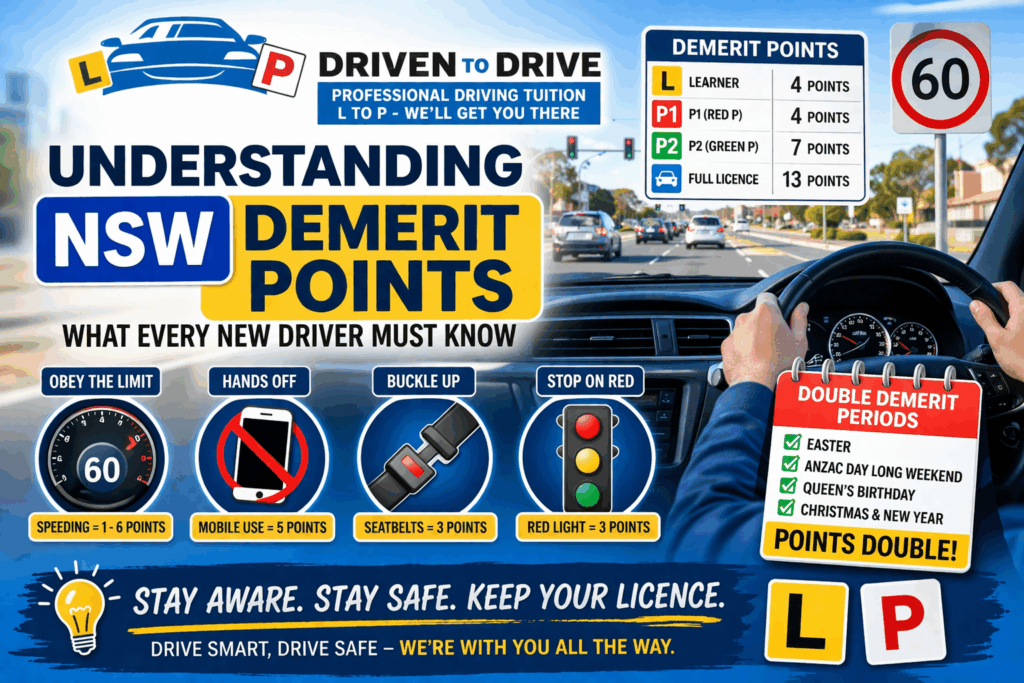
Failing to give way to an emergency vehicle and failing to comply with the Move Over Law are specific offences under the NSW Road Rules 2014. Each carries fines and demerit points. For learner and P1 drivers who hold only 4 demerit points, even a single offence can result in a minimum 3-month licence suspension. Penalties vary by offence and severity — always refer to Service NSW (service.nsw.gov.au) for the most current information. |
Official Government Resources
📋 Official Government Resources
|
| Ready to Drive with Confidence in Any Situation?
Knowing the road rules is one thing — responding calmly when it counts is another. At Driven to Drive, we prepare learners across Mascot, Botany, Rosebery, Eastlakes, Maroubra, Randwick, and Bondi to handle real-world driving scenarios with skill and composure. Our lessons cover emergency vehicle responses, hazard perception, and every situation you’re likely to face on the road. Join our Safer Drivers Course and earn 20 logbook hours while building the situational awareness to drive safely for life. Andrew is available to answer questions and help you book. 📞 0416 321 572 📧 driventodrive@outlook.com 🌐 driventodrive.com.au Book your lesson today — South Eastern Sydney’s trusted driving school for over 11 years. |
| Disclaimer: This blog provides general driving information only. Always refer to official NSW Government sources for the latest road rules, penalties, and licensing requirements. Driven to Drive recommends consulting Service NSW (service.nsw.gov.au) and Transport for NSW (transport.nsw.gov.au) directly for current rules. |