
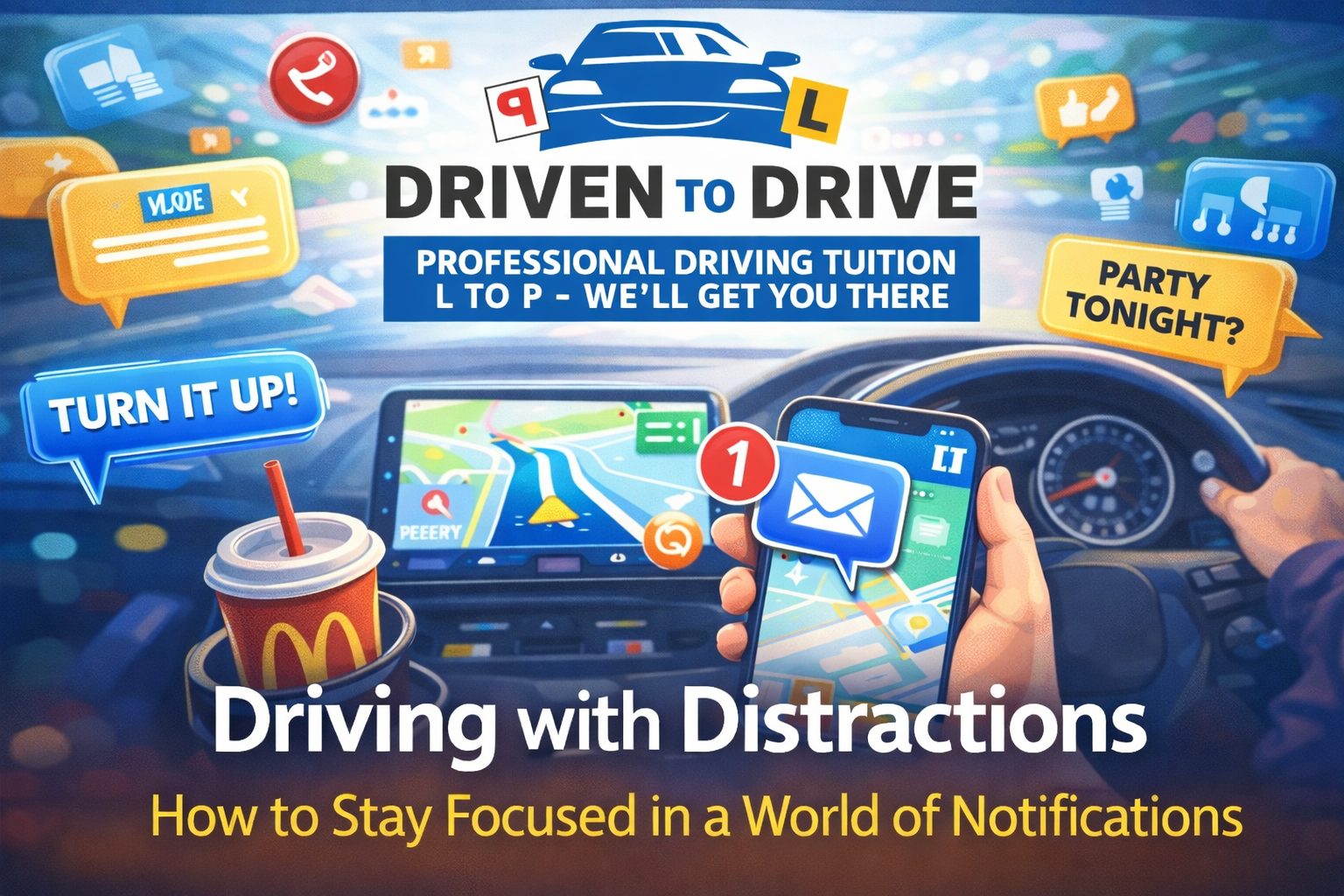
Driving with Distractions: How to Stay Focused in a World of Notifications
Meta Description: A practical guide for NSW learner and P-plate drivers on managing mobile phones, passengers, music, and mental distractions behind the wheel.
Introduction
At just 60 km/h, taking your eyes off the road for a few seconds means travelling the length of a football field blind. In today’s world of constant notifications, that’s a risk many drivers take without realising.
For learner drivers and P-platers across Sydney’s South Eastern Suburbs — from Mascot to Maroubra — distractions are one of the biggest threats to safety. According to Transport for NSW, distraction is a key factor in a significant number of crashes, especially among younger and less experienced drivers.
At Driven to Drive Driving School, we’ve spent over 11 years helping learners build safe, confident driving habits. Led by Andrew, a certified Safer Drivers Course facilitator, our approach focuses on real-world skills — including how to stay focused in high-pressure, distraction-heavy environments.
In this guide, we’ll break down NSW mobile phone laws, the types of distractions you need to understand, and practical strategies to help you stay in control every time you drive.
NSW Laws on Mobile Phone Use While Driving
Understanding the law is the first step to staying safe — and avoiding serious penalties.
Learner and P1 Drivers
According to Service NSW:
- You must not use a mobile phone at all while driving
- This includes:
- Hands-free calls
- Bluetooth
- GPS
- Music streaming
Even touching your phone while stopped at traffic lights is illegal.
P2 and Full Licence Drivers
- Hands-free use is allowed (e.g. Bluetooth or mounted phone)
- You must not hold the phone at any time
What Counts as “Use”?
NSW rules are strict. “Use” includes:
- Holding the phone
- Resting it on your lap
- Operating apps (navigation, music, messages)
- Even briefly touching it
Penalties
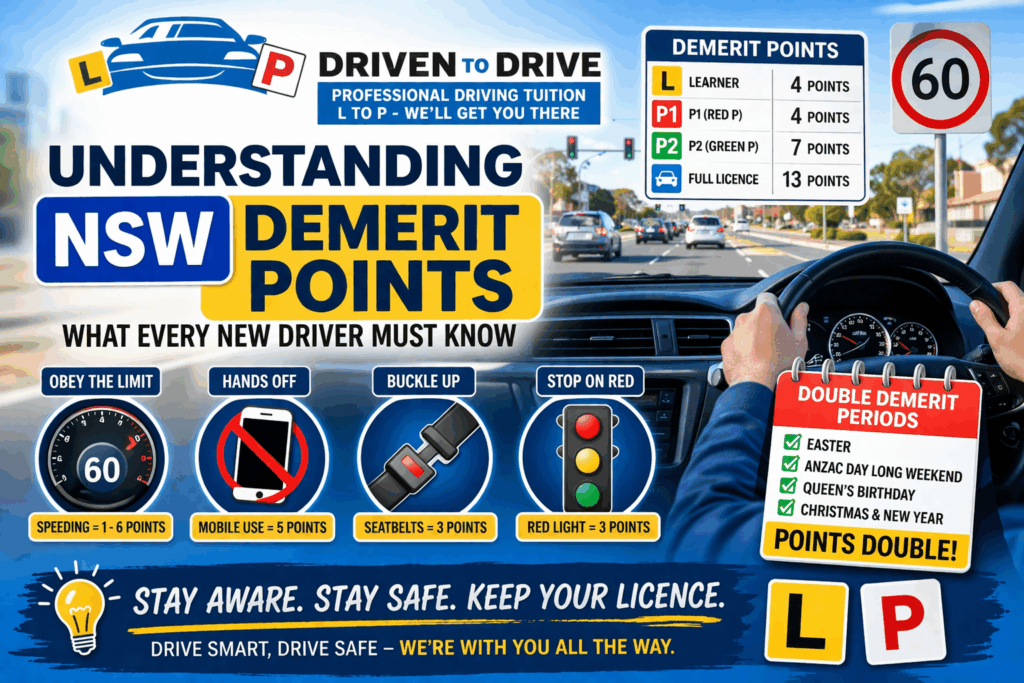
- Learners only have 4 demerit points
- Exceeding this leads to a minimum 3-month suspension
- Mobile phone offences carry heavy penalties, especially during double demerit periods
👉 Always check Service NSW for the most current penalty details.
The 4 Types of Driving Distraction
Distraction isn’t just about phones — it’s anything that takes your attention away from driving.
1. Visual Distraction
Taking your eyes off the road
Examples:
- Looking at GPS too long
- Watching an incident on the roadside
2. Manual Distraction
Taking your hands off the wheel
Examples:
- Eating or drinking
- Adjusting controls
3. Cognitive Distraction
Taking your mind off driving
Examples:
- Daydreaming
- Emotional stress or arguments
4. Auditory Distraction
Sounds that break your focus
Examples:
- Notifications
- Loud music
🚨 Phones are especially dangerous because they involve ALL four types at once.
Common Distractions for New Drivers
New drivers are more vulnerable because driving isn’t yet automatic — it requires full concentration.
Passengers
- Friends can create pressure or distractions
- Conversations can pull your attention away
Music & Podcasts
- Changing songs or playlists
- Volume adjustments
GPS Navigation
- Looking at the screen too often
- Reacting late to directions
Food & Drink
- Common during long drives or busy days
Emotional State
- Stress, anxiety, or frustration impacts decision-making
💡 Pro Tip: Set everything up before you start the engine — GPS, music, mirrors, and seat position.
Real-World Driving Scenarios (Sydney Focus)
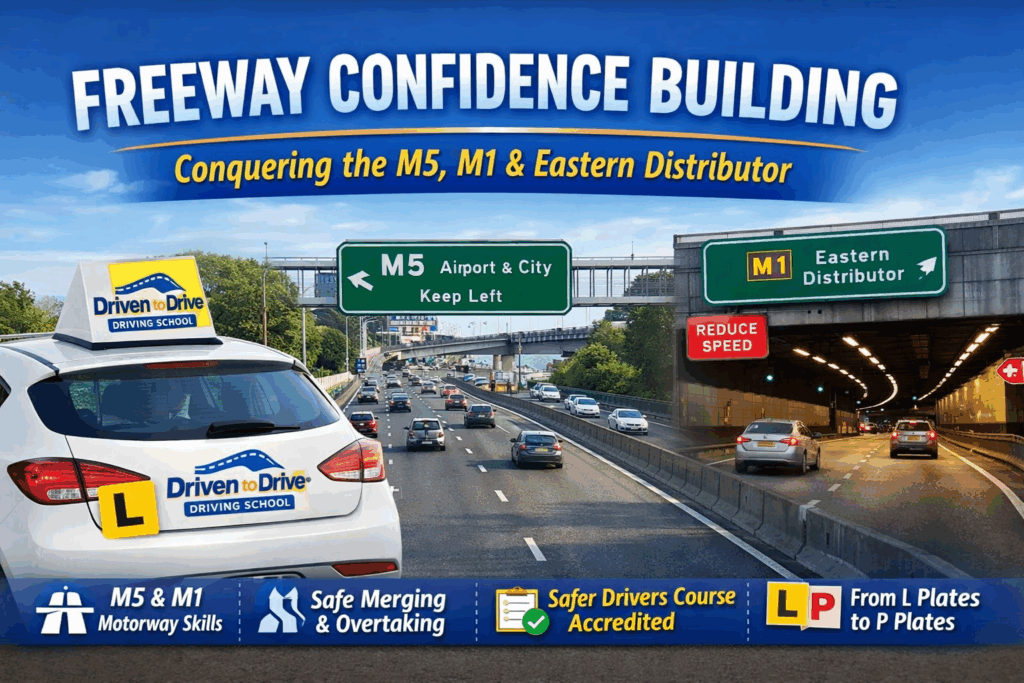
Scenario 1: Merging onto Southern Cross Drive (Mascot)
The Challenge: Heavy traffic, high speeds, and GPS instructions.
NSW Rule: Maintain control and give way appropriately when merging (Road User Handbook – Transport for NSW).
Driven to Drive Approach:
- Set GPS before moving
- Check mirrors and blind spots early
- Match speed with traffic
- Avoid last-second decisions
Scenario 2: Driving Through a Busy Roundabout in Maroubra
The Challenge: Multiple entry points, visual distractions, and pressure from other drivers.
Safe Approach:
- Slow down and assess all exits
- Focus only on relevant vehicles
- Ignore distractions outside the roundabout
- Indicate clearly when exiting
Scenario 3: Friends Talking Loudly in the Car
The Challenge: Cognitive overload and reduced focus.
Driven to Drive Tip:
- Politely say: “I need to focus here for a second”
- Reduce conversation during complex driving situations
Scenario 4: Phone Notification While Driving in Botany
The Challenge: Urge to check messages.
NSW Rule: Learners must not use phones at all.
Safe Approach:
- Ignore it — it can wait
- If urgent, pull over safely
- Never check at traffic lights
Scenario 5: Feeling Flustered After a Mistake in Randwick
The Challenge: Losing focus after a near-miss.
Driven to Drive Approach:
- Take a breath
- Reduce speed slightly
- Increase following distance
- Refocus on the road ahead
Common Mistakes & How to Avoid Them
- Checking your phone at lights → Still illegal for learners
- Not scanning ahead → Keep your eyes moving
- Letting passengers distract you → Set boundaries early
- Over-relying on GPS → Use it as a guide, not your focus
- Driving while stressed → Reset your mindset before continuing
The Safer Drivers Course (NSW)
The Safer Drivers Course, supported by NSW Centre for Road Safety, is one of the best ways to improve focus and hazard awareness.
What You’ll Learn:
- Hazard perception and risk management
- Managing distractions effectively
- Making safer decisions under pressure
Benefits:
- Earn 20 logbook hours
- Build real-world driving confidence
- Improve readiness for the driving test
At Driven to Drive, Andrew delivers this course in a structured, calm, and supportive environment, helping learners develop skills that last well beyond the test.
Practical Tips for Staying Focused
- Use Do Not Disturb While Driving mode
- Mount your phone for GPS only (no interaction)
- Create a pre-drive routine:
- Mirrors
- Seat position
- Phone on silent
- GPS set
- Pull over safely if needed — never multitask
- Practice in low-distraction environments first
What to Do If You Get Distracted Mid-Drive
- Acknowledge it and refocus immediately
- Reduce speed slightly
- Increase following distance
- If necessary, pull over safely
- Reset mentally before continuing
For Parents: Modelling Good Behaviour
Parents play a critical role in shaping safe driving habits.
- Avoid using your phone while supervising
- Stay alert and ready to take control
- Praise focus, not just outcomes
- Introduce distractions gradually
Learners copy what they see — your habits matter.
Conclusion
The most dangerous moment on the road isn’t always speed — it’s the second you stop paying attention.
For learner drivers and P-platers, building focus isn’t just about passing a test — it’s about developing lifelong driving habits that keep you and others safe.
At Driven to Drive Driving School, we specialise in helping learners across Mascot and Sydney’s South Eastern Suburbs build confidence, awareness, and control — step by step.
Ready to Drive with Confidence?
Ready to become a safe, focused, and confident driver?
Book your lessons with Driven to Drive — South Eastern Sydney’s trusted driving school for over 11 years.
📞 0416 321 572
📧 driventodrive@outlook.com
🌐 https://driventodrive.com.au
Or join our Safer Drivers Course in Mascot and earn 20 logbook hours while learning skills that last a lifetime.
Government References
- Transport for NSW – Learner Driver Resources
- Service NSW – Getting Your Licence
- Road User Handbook (latest edition)
- NSW Centre for Road Safety – Safer Drivers Course
Disclaimer: This blog provides general driving information only. Always refer to official NSW Government sources for the latest rules, penalties, and licensing requirements.