
Introduction
Parallel parking is one of the most essential — and most intimidating — driving skills for learner drivers in Sydney. With narrow residential streets, high parking demand, and busy areas like Mascot, Randwick, and Bondi, being able to park confidently between two vehicles is not optional — it’s a daily reality.
For many learners and supervising parents, parallel parking causes anxiety, frustration, and self-doubt. However, when taught correctly and practised calmly, it becomes a repeatable, logical process rather than a guessing game.
At Driven to Drive Driving School, Andrew has helped learners transition from L plates to P plates for over 11 years, focusing on safe habits, clear reference points, and confidence under pressure. This guide explains how parallel parking works in NSW, the road rules that apply, and the step-by-step method taught during professional lessons and the Safer Drivers Course, helping learners build a skill they’ll use for life — not just for the driving test.
Understanding the Basics of Parallel Parking
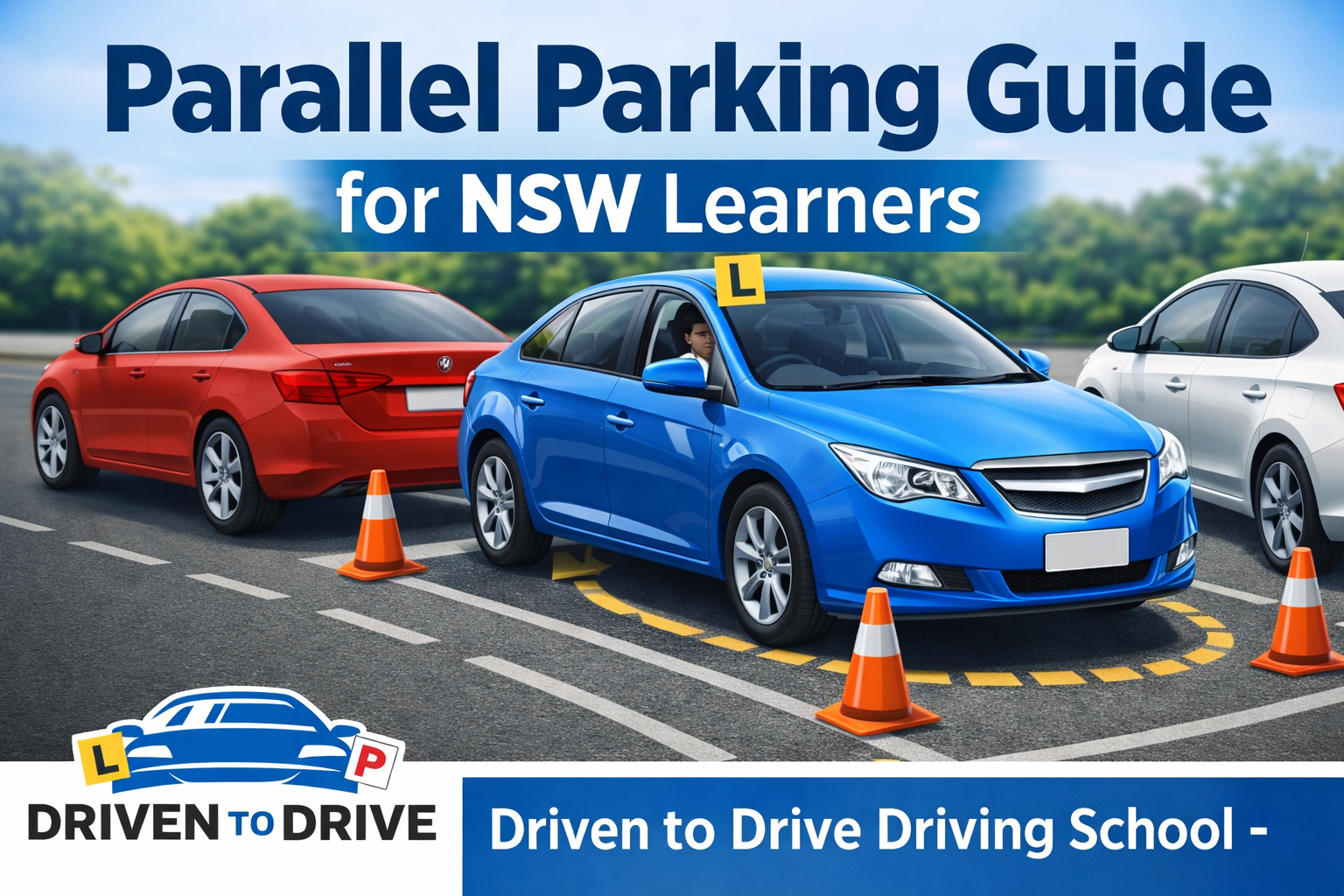
Parallel parking involves reversing a vehicle into a space between two parked cars, positioning the vehicle safely and legally along the kerb.
Why Parallel Parking Is Challenging
Learners often struggle because it requires:
- Controlled reversing
- Accurate steering input
- Spatial awareness
- Confidence in mirror use rather than guesswork
NSW driving assessments expect learners to demonstrate full control, observation, and compliance with road rules, not speed or perfection.
Space Requirements
According to guidance in the Road User Handbook, learners should only attempt a parallel park when the space is at least 1.5 times the length of their vehicle. If the space is too tight, it is safer — and perfectly acceptable — to keep driving and find another spot.
Choosing a Legal Parking Spot
Before attempting to park, learners must check:
- Parking signs and time restrictions
- Clearways and bus zones
- Driveway access
- Fire hydrants and intersections
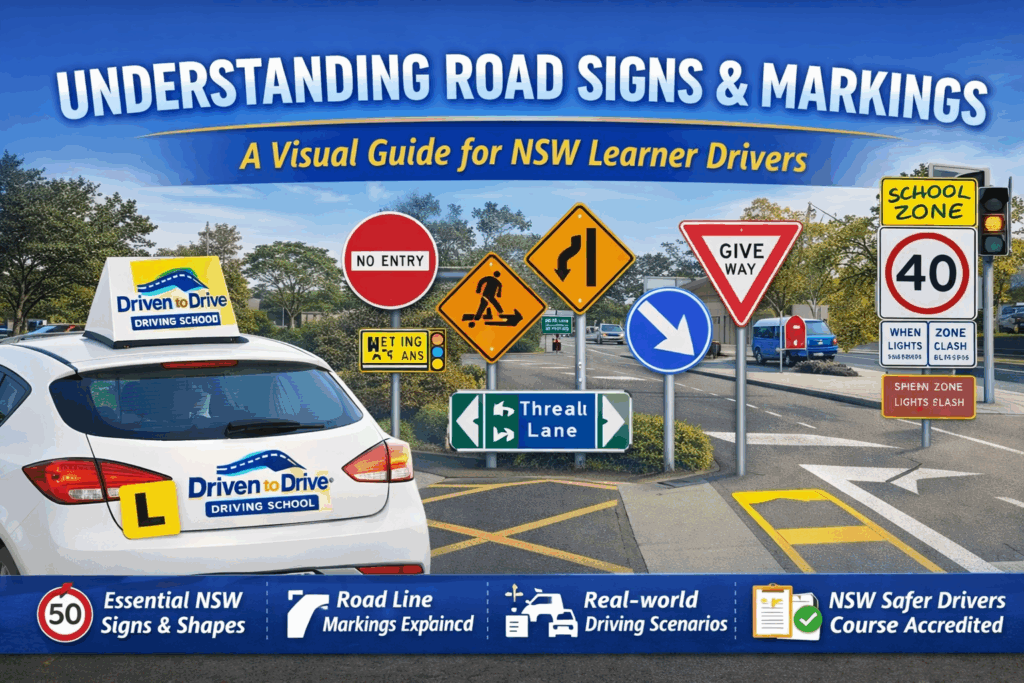
Parking rules and restrictions are enforced by local councils and NSW authorities, and learners are expected to demonstrate awareness of signage at all times.
Vehicle Setup & Positioning
Correct positioning before reversing makes parallel parking significantly easier.
Pulling Alongside the Front Vehicle
- Pull up parallel to the car in front of the space
- Align your vehicle so both cars are facing the same direction
Distance from the Parked Car
Andrew teaches learners to maintain approximately 30–50 cm between vehicles — close enough for control, but with safe clearance.
Safety Checks
Before reversing, learners must:
- Check mirrors
- Perform head checks for pedestrians, cyclists, and vehicles
- Indicate left to show intent (as required under NSW road rules)
Step-by-Step Parallel Parking Method (NSW-Compliant)
This method focuses on repeatability and control, not rushed movements.
Step 1: Position and Observe
- Stop beside the front car
- Confirm the space is legal and safe
- Indicate left
Step 2: Full Lock Reverse
- Reverse slowly
- Apply full steering lock (usually left when parking on the left)
- Maintain steady speed — no rushing
Step 3: Watch Reference Points
- Use mirrors to track the rear of the front vehicle
- Monitor kerb distance carefully
Step 4: Straighten the Wheel
- Once the vehicle’s rear clears the front car, straighten the steering wheel
- Continue reversing slowly
Step 5: Reverse Straight Back
- Allow the vehicle to enter the space evenly
- Check both mirrors continuously
Step 6: Final Adjustments
- Straighten wheels
- Adjust forward or backward to centre the car
- Ensure the vehicle is parallel to the kerb and within 30 cm where practical
Reference Points & Mirror Usage
Mirrors vs Rear Window
NSW testing standards expect learners to rely primarily on mirrors and head checks, not twisting around continuously.
Finding Your Reference Points
Each vehicle differs. During lessons, Andrew helps learners identify:
- When to start steering
- When to straighten
- When to stop reversing
This builds confidence across different cars — an essential lifelong skill.
Common Mistakes & How to Fix Them
Starting Too Close or Too Far
Incorrect starting distance leads to kerb strikes or poor alignment. Reset calmly if needed.
Not Reversing at Enough Angle
Learners often hesitate — commitment with control is safer than half-turns.
Hitting the Kerb
If the kerb approaches, stop immediately, adjust forward, and try again — this shows control, not failure.
Ending Too Far from the Kerb
If the vehicle is more than 30 cm away, learners should adjust forward and re-align.
Advanced Parallel Parking Techniques
Parking on Hills
When parking on a hill, NSW rules require:
- Wheels turned appropriately
- Handbrake applied
- Vehicle secured before exiting
Left vs Right-Side Parking
Learners may be asked to park on either side of the road during testing. Professional instruction ensures familiarity with both.
Busy Street Parking
In areas like Maroubra or Randwick, learners are taught to:
- Stay calm
- Ignore pressure from other drivers
- Complete the manoeuvre safely and legally
Practice Locations Around Sydney’s Eastern Suburbs
Andrew gradually increases difficulty by practising in:
- Quiet streets in Rosebery and Eastlakes
- Moderate traffic zones in Mascot
- Test-route style locations used by NSW testing officers
- Busier streets closer to Bondi and Randwick
This structured exposure builds real-world confidence.
Technology Helpers — and Their Limits
Parking Sensors & Cameras
These can assist but do not replace observation. Learners must still check mirrors and blind spots.
Auto-Parking Features
NSW testing requires learners to demonstrate manual control. Relying on automation alone is not sufficient.
The Safer Drivers Course: Building Real-World Confidence
The NSW Safer Drivers Course is available to learners under 25 who have completed at least 50 logbook hours.
The course:
- Develops hazard perception and risk awareness
- Teaches calm decision-making under pressure
- Addresses distractions and real-world driving challenges
- Provides 20 bonus logbook hours toward the required 120
At Driven to Drive, Andrew is a certified Safer Drivers Course facilitator, delivering the program in a supportive, structured environment focused on lifelong safety — not shortcuts.
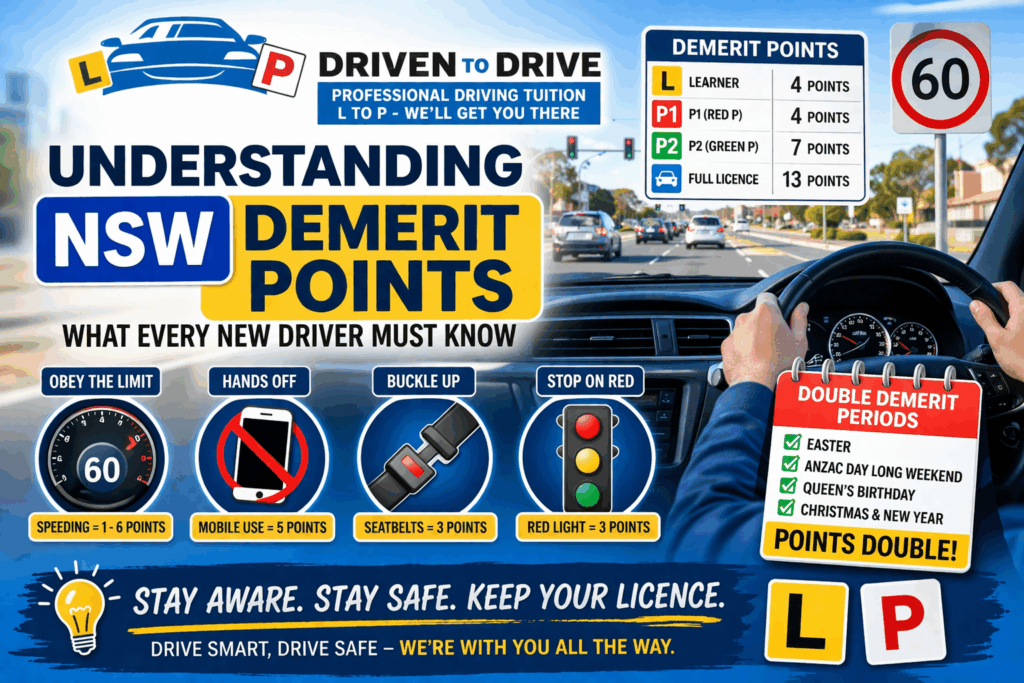
Penalties & Demerit Points (Learner Drivers)
NSW learner drivers are limited to 4 demerit points.
Exceeding this limit results in:
- A minimum 3-month licence suspension
Penalties vary depending on the offence and circumstances. Always check Service NSW for current information.
Expert Parallel Parking Tips from Driven to Drive
- Slow is smooth — smooth is safe
- Use mirrors proactively, not reactively
- Plan the manoeuvre before moving
- Ignore pressure from other drivers
- Treat the driving test like normal driving
Government References (Official NSW Sources)
- Transport for NSW – Learner Driver Resources
- Service NSW – Getting Your P1 Licence
- Road User Handbook (latest edition)
- NSW Centre for Road Safety
- Safer Drivers Course
Ready to Park with Confidence?
Ready to become a safe, confident driver?
Book your lessons with Driven to Drive Driving School — proudly helping learners across Mascot and Sydney’s South Eastern Suburbs transition from Ls to Ps for over 11 years.
📍 Mascot, NSW 2020
📞 0416 321 572
🌐 https://driventodrive.com.au
✉️ driventodrive@outlook.com
Disclaimer: This blog provides general driving information only. Always refer to official NSW Government sources for the latest road rules, penalties, and licensing requirements.