
Dashboard Warning Lights Every New Driver Should Recognise
A light appears on the dashboard somewhere between Mascot and Maroubra. It is a symbol you have never seen before. Do you pull over? Keep going? Ignore it until the weekend? Understanding dashboard warning lights meaning is one of the most practical skills a new driver can have, and it is almost never covered in the rush to pass a test.
Yet it is the difference between a cheap repair and an expensive one, and occasionally between a safe stop and a dangerous one. Driven to Drive has taught learners across Sydney’s South Eastern Suburbs for more than 11 years, and this is the guide we wish every new driver read before their first solo drive.
The colour code: the only thing you must memorise
Manufacturers use different symbols, but the colour convention is near universal.
- Red means stop. Something is wrong that can hurt you or seriously damage the vehicle. Pull over safely as soon as you can and investigate before continuing.
- Amber or orange means caution. Something needs attention, but you are generally not in immediate danger. Get it checked soon rather than now.
- Green or blue means information. A system is simply switched on. Headlights, indicators, cruise control. Nothing is wrong.
If you remember nothing else from this article, remember that. A new driver who reacts correctly to colour alone will handle almost every situation acceptably. Your owner’s manual defines every symbol in your specific car, and it lives in the glovebox.
Red lights: stop safely and investigate
Oil pressure warning, usually an oil can symbol
This is one of the most serious. Low oil pressure can destroy an engine within minutes. Pull over safely, switch off the engine, and do not continue driving. Check the oil level once the engine has cooled, and seek assistance.
Engine temperature warning, usually a thermometer in liquid
The engine is overheating. Pull over safely and switch off. Do not open the radiator cap while the engine is hot, because escaping steam and coolant cause serious burns. Wait for it to cool and seek assistance.
Brake system warning
This may indicate the parking brake is still engaged, which is the harmless version, or a genuine fault including low brake fluid. Check the parking brake first. If it is off and the light remains, treat it as serious and stop.
Battery or charging system warning
The battery is not being charged, often a failed alternator or belt. The vehicle may continue running for a short time on battery alone, then stop entirely, potentially without power steering. Drive directly somewhere safe rather than continuing your journey.
Airbag warning
The airbag system has a fault and may not deploy in a crash. The car will drive normally, which is exactly why people ignore it. Have it checked promptly.
Amber lights: attend to it soon
Check engine or engine management light
This covers a wide range of faults, from a loose fuel cap to something significant. If the car is driving normally, book a diagnostic check. If it is flashing, or the car is running roughly or losing power, treat it as urgent and stop safely.
ABS warning
The anti-lock braking system has a fault. Your ordinary brakes generally still work, but the anti-lock function may not, which matters most in an emergency stop or on a wet road. Get it checked promptly and increase your following distance until you do.
Tyre pressure monitoring warning
One or more tyres is low. Check pressures at the next opportunity. If the car is also handling oddly, pulling to one side or feeling unstable, stop safely and inspect the tyres, because this may be a deflating tyre rather than gradual pressure loss.
Traction control or stability control light
If it flashes briefly while driving, the system is working, usually on a wet or loose surface. That is normal. If it stays on steadily, the system has a fault and may be disabled.
Green and blue: information only
Headlights on, high beam engaged, indicators, fog lights, cruise control. These confirm a system is active. The one worth watching is high beam, because leaving it on dazzles oncoming drivers and is both discourteous and unsafe.
Four scenarios and what to do
A red temperature light appears on a busy road near Mascot
Indicate early, move left when there is a safe gap, and get completely off the carriageway. Switch off the engine. Turn on hazard lights. If you leave the vehicle, exit away from traffic and stand well clear, behind a barrier if one exists, never between the vehicle and moving traffic. Call for assistance. See crashes and hazards.
An amber check engine light appears on the way to work
The car is driving normally. There is no need to stop on the roadside. Continue to your destination at a normal speed, then book a diagnostic check. If it starts flashing or the car begins running roughly, treat it as a red light and stop safely.
A tyre pressure warning with the car pulling to one side
This combination suggests an actual deflation rather than gradual loss. Slow gradually, avoid heavy braking or sudden steering, and pull over somewhere safe and level. Do not attempt a tyre change on the traffic side of a busy road, wait for assistance.
A warning light appears during a driving test or lesson
Tell your instructor or testing officer immediately rather than hoping it goes away. In a lesson, the instructor will manage it. Concealing it is the only genuinely wrong response.
Common mistakes and how to avoid them
- Ignoring amber lights because the car feels fine. Amber means soon, not never.
- Treating every light as an emergency and stopping in an unsafe place. Where you stop matters as much as whether you stop.
- Opening the radiator cap on a hot engine.
- Driving on with a red oil or temperature light just to get home.
- Never opening the owner’s manual. Every symbol in your specific car is defined in it.
- Not doing basic checks. Most warning lights are preceded by weeks of a condition you could have spotted.
A simple pre-drive habit
When you start the car, the warning lights illuminate briefly then go out. That is a self-test. Watch it. Two things matter. Any light that stays on after start-up needs attention. Any light that never illuminates at all may indicate a failed bulb, which means a real warning may never reach you. It takes two seconds and it is the cheapest maintenance habit there is.
The Safer Drivers Course
For learners under 25 working toward their Ps, the Safer Drivers Course builds hazard awareness and risk perception, encourages safe decision-making and handling distractions, and contributes 20 logbook hours toward the 120-hour requirement.
Andrew is a certified Safer Drivers Course facilitator and delivers the course in a structured, safe and supportive environment.
Recognising a warning light is knowledge. Deciding calmly what to do about it while driving in traffic is judgement, and judgement is what the course develops.
Penalties and demerit points
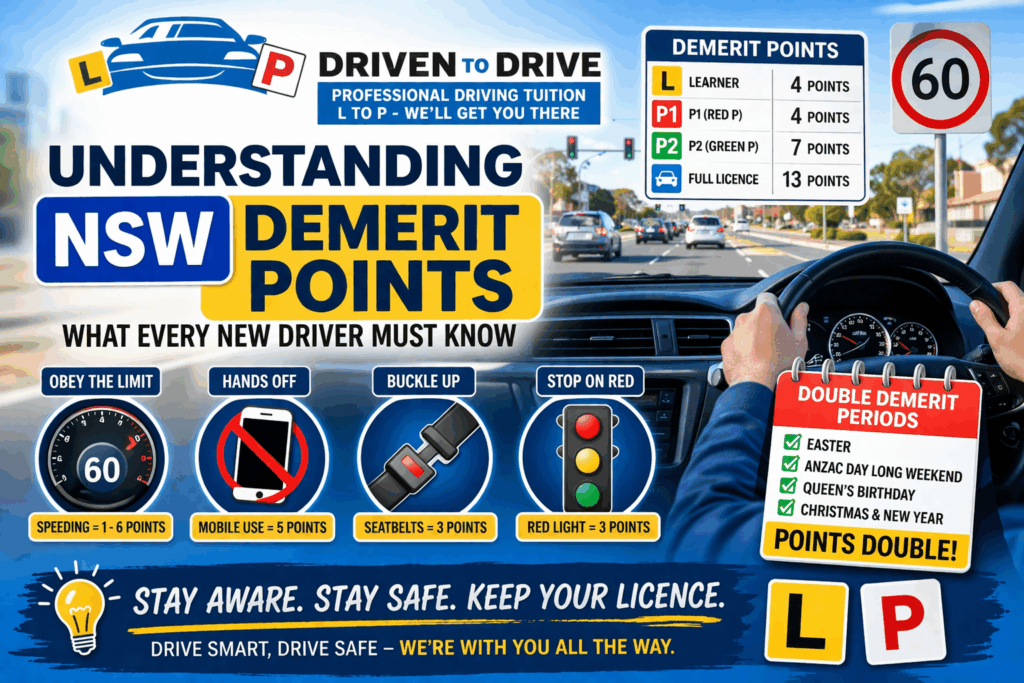
NSW learners hold only 4 demerit points, and exceeding this results in a minimum three-month suspension. P1 drivers are also on 4 points, P2 drivers on 7. Specific fine amounts are not listed here, because penalties vary by offence and severity. Refer to Service NSW and how demerit points work for current details.
Driving a vehicle that is not roadworthy can itself attract penalties.
Tips from Andrew
- Read the warning lights page of your owner’s manual once, before you need it.
- Learn the colour code. It covers you even when you do not recognise the symbol.
- Check your tyre pressures monthly. It prevents the most common warning of all.
- Practise pulling over safely and calmly, so that when a red light appears you are executing a habit rather than improvising.
- Never ignore a red light to finish a journey. The journey is not worth an engine.
Frequently asked questions
What do the dashboard warning light colours mean?
Red means stop safely as soon as possible and investigate. Amber or orange means something needs attention soon but is not usually an immediate danger. Green or blue is information only, confirming a system is switched on.
What should I do if the engine temperature light comes on?
Pull over safely, switch off the engine and let it cool. Do not open the radiator cap while hot, as escaping steam and coolant can cause serious burns. Seek assistance rather than continuing to drive.
Is it safe to drive with the check engine light on?
If the car is driving normally, you can generally continue to your destination and book a diagnostic check. If the light is flashing, or the car is running roughly or losing power, stop safely as soon as you can.
What does the ABS light mean?
The anti-lock braking system has a fault. Your normal brakes usually still work, but the anti-lock function may not, which matters most in emergency braking or wet conditions. Increase your following distance and have it checked promptly.
What if a warning light appears during my driving test?
Tell the testing officer immediately. It is the correct and safe response, and attempting to conceal it is worse than the fault itself.
Ready to become a safe, confident driver?
Book your lessons with Driven to Drive, South Eastern Sydney’s trusted driving school for over 11 years. Or join our Safer Drivers Course in Mascot and earn 20 logbook hours while learning the skills to drive safely for life.
Government references
This blog provides general driving information only. Always refer to official NSW Government sources for the latest rules, penalties and licensing requirements.
| Ready to Build Your Confidence Behind the Wheel?
The first solo drive is a mental milestone as much as a practical one — and preparation is everything. At Driven to Drive, we have helped hundreds of Sydney learners transition from L plates to P plates with calm, expert-guided instruction across Mascot, Botany, Rosebery, Eastlakes, Maroubra, Randwick, Bondi, and the South Eastern Suburbs. Whether you are still logging hours, preparing for your driving test, or looking for P-plate coaching after you have passed — Andrew and the Driven to Drive team are here to help you drive safely for life. 📞 0416 321 572 📧 driventodrive@outlook.com 🌐 driventodrive.com.au Book your lesson today — and let’s make every drive a confident one. |
| Disclaimer: This blog provides general driving information only. Always refer to official NSW Government sources for the latest road rules, penalties, and licensing requirements. Driven to Drive recommends consulting Service NSW (service.nsw.gov.au) and Transport for NSW (transport.nsw.gov.au) directly for all current licence conditions. |