
Introduction
The car door closes. Your supervisor steps back onto the footpath. The engine is running — and for the first time, you are the only one responsible for what happens next.
That moment is both exhilarating and, for most new drivers, deeply nerve-wracking.
Passing your driving test and receiving your P1 licence is one of the most significant milestones of young adulthood. But the shift from supervised learner to independent P-plater isn’t just a legal change — it’s a psychological one. Suddenly, there’s no instructor to confirm your mirrors are set correctly, no parent in the passenger seat to remind you to check your blind spot. You’re on your own.
At Driven to Drive, based in Mascot and serving learners across Sydney’s South Eastern Suburbs, we’ve spent more than 11 years preparing drivers-in-training for exactly this moment. In this guide, we’ll walk you through what to expect on your first solo drive, how to plan it well, and how to keep building confidence in the weeks that follow.
What Changes When You Get Your P1 Licence
Understanding your new responsibilities is the best way to feel ready for them. According to Service NSW, the following rules apply once you hold a P1 licence in NSW:
P1 Licence Restrictions at a Glance
Source: Service NSW — Provisional P1 licence conditions (service.nsw.gov.au) |
These rules exist to protect new drivers during the highest-risk period of their driving lives. Research from the NSW Centre for Road Safety confirms that crash risk is significantly elevated in the first year of independent driving — which is precisely why these graduated restrictions are in place.
Always refer to the Service NSW website for the complete and current list of P1 licence conditions.
What to Expect on Your First Solo Drive
No amount of supervised practice fully prepares you for the feeling of driving alone. Here is what many new P-platers experience — and why it is entirely normal:
→ Everything feels louder and faster. Without a supervisor in the car, your senses naturally heighten. You may notice sounds you never registered before — the rumble of a bus, the screech of brakes nearby. This is your brain doing its job. Stay calm and trust your training.
→ Decision-making feels heavier. During lessons, there was always someone to confirm your choices. Now, when you approach an intersection near Mascot or navigate a roundabout in Rosebery, the decision is entirely yours. This is a significant shift — but one you have been trained for.
→ You may drive more cautiously. Slowing down slightly, giving yourself extra following distance, hesitating before a lane change — these are all completely reasonable responses to driving solo for the first time. Being cautious is not the same as being unsafe.
→ The car hasn’t changed. This sounds obvious, but it is worth reminding yourself: the vehicle behaves exactly as it did during your 120 logged hours of practice. You know this car. Trust your muscle memory.
Most new P-platers report the same thing after their first solo drive: ‘It was shorter than I expected — and much better than I feared.’
How to Plan Your First Solo Drive for Success
A well-planned first solo trip dramatically reduces anxiety. Here is how to set yourself up:
- Choose a familiar route. This is not the time for adventure. Drive somewhere you have already travelled during your lessons — a route with intersections and landmarks you recognise.
- Go at a low-pressure time. Mid-morning on a weekday is ideal. Avoid school zones, peak-hour traffic, and high-traffic arterials for your first few trips. Sydney’s South Eastern Suburbs can be particularly busy around Eastlakes and Botany during school drop-off and pick-up times — plan around these where you can.
- Use legal navigation alternatives. P1 drivers cannot legally use a smartphone for navigation in any form — not hands-free, not audio-only, not in a cradle. If you need turn-by-turn directions, use a standalone GPS unit (such as a TomTom or Garmin) or the car’s in-built factory sat-nav system. If you have neither, study your route carefully before starting the engine. Keep your phone charged but put it away before you drive.
- Tell someone your plan. Let a parent or trusted adult know where you are going and when you expect to return. This is straightforward safety practice — not a limitation.
- Avoid motorways and expressways initially. Merging at higher speeds onto a busy motorway is a skill best introduced gradually. Start with familiar suburban roads and build up from there.
Managing First-Drive Nerves
Nervousness before your first solo drive is entirely normal — and manageable. Here are techniques that genuinely help:
| Box Breathing — Try This Before You Pull Away
Inhale for 4 counts → Hold for 4 counts → Exhale for 4 counts → Hold for 4 counts Repeat 3–4 times. This slows the nervous system and reduces the cortisol spike that creates panic. Do it in the car before you turn the key. |
- Remind yourself of your hours. You have completed 120 logbook hours. That is real, substantial experience. You are not an inexperienced driver — you are a newly independent one. There is a meaningful difference.
- Focus on the next kilometre, not the whole trip. Break the drive into smaller moments. Don’t think about arriving — think about navigating this corner, this roundabout, this set of lights. One decision at a time.
- Choose your music carefully. A calm, familiar playlist can be grounding. High-energy or emotionally charged music can increase arousal and draw your attention from the road. Keep it low and easy for your first few solo drives.
- If you feel overwhelmed, pull over safely. There is no shame in finding a safe spot, putting the car in park, and taking a breath. Your safety — and the safety of others on the road — always comes first.
Building Confidence in Your First Few Weeks as a P-Plater
Confidence behind the wheel isn’t switched on the moment you receive your licence. It builds gradually — and deliberately. Here is a practical week-by-week approach:
- Week 1: Stick to familiar local routes during daylight hours only. Keep trips short and purposeful. Focus on consistency over distance.
- Weeks 2–3: Gradually extend your trips. Try driving at different times of day — late morning, then early afternoon. Begin to notice how traffic patterns shift at different hours.
- Week 4 and beyond: Introduce one new challenge at a time. A moderately busy arterial road. A new suburb. A short stretch of expressway during off-peak hours. Night driving — keeping in mind that if you are under 25, you may only carry one passenger under 21 between 11:00 PM and 5:00 AM.
This approach — sometimes called progressive exposure by driving instructors — is exactly how Driven to Drive teaches learners to build real, lasting road confidence. The same principle applies after you receive your P-plates.
| 💡 Tip: Continue Professional Lessons After Your P-Plates
Many drivers continue with a professional instructor after getting their P1 — and it makes a significant difference. At Driven to Drive, we offer P-plate coaching specifically designed to help new drivers navigate the challenges of independent driving in a structured, supportive environment. Ask Andrew about post-licence lessons on 0416 321 572. |
For Parents: Letting Go
This section is for the parents reading along — because the first solo drive is a milestone for you too.
Your anxiety is real and valid. But try not to project it onto your new P-plater before they drive away. A tense send-off can heighten their stress at exactly the wrong moment. Instead, aim for calm, practical support.
Before They Leave
- Set calm, clear expectations: Agree on the route, check-in times, and what to do in an emergency — without making it feel like a debrief.
- Make sure they know what to do if something goes wrong: Who do they call if the car breaks down? Do they know the basic steps after a minor collision? A brief, practical conversation now prevents panic later.
- Confirm they have everything they need: Licence, a charged phone stowed away (not in use or in a mount), navigation sorted before they leave, and a clear sense of the route.
When They Return
- Ask open questions, not interrogating ones: ‘How did it feel?’ rather than ‘Did anything go wrong?’
- Acknowledge the effort, not just the outcome: Even a nerve-wracking drive is a successful drive if they handled it safely.
- Celebrate the milestone. Getting a P1 licence in NSW takes real commitment — 120 hours of supervised driving, a knowledge test, and a driving test. Your new P-plater has earned this moment.
Expert Tips from Driven to Drive
These are the principles our instructors reinforce at every stage of driver education — and they apply just as much on your first solo drive as they do during your lessons:
- Always check mirrors before every lane change or turn. Not a quick glance — a deliberate scan that includes your blind spots. This habit, formed during your 120 hours, must carry into every solo drive.
- Maintain a three-second following distance on suburban roads. Extend this in wet weather or low visibility conditions, as recommended by the NSW Road User Handbook. If the car ahead passes a fixed point and you reach it in under three seconds, you are too close.
- Plan your turns and merges early. Indicate well in advance, adjust your speed before the manoeuvre — not during it. This applies especially to busy intersections around Mascot and Maroubra, where lanes narrow and traffic moves unpredictably.
- Stay calm when other drivers are not. If someone tailgates or behaves aggressively behind you, don’t speed up — find a safe opportunity to change lanes or allow them to pass. Your composure is the most powerful tool you have on the road.
- Drive to conditions, not just the speed limit. In wet weather, near school zones, or in areas with heavy pedestrian activity, slower is always safer. The speed limit is a maximum — not a target.
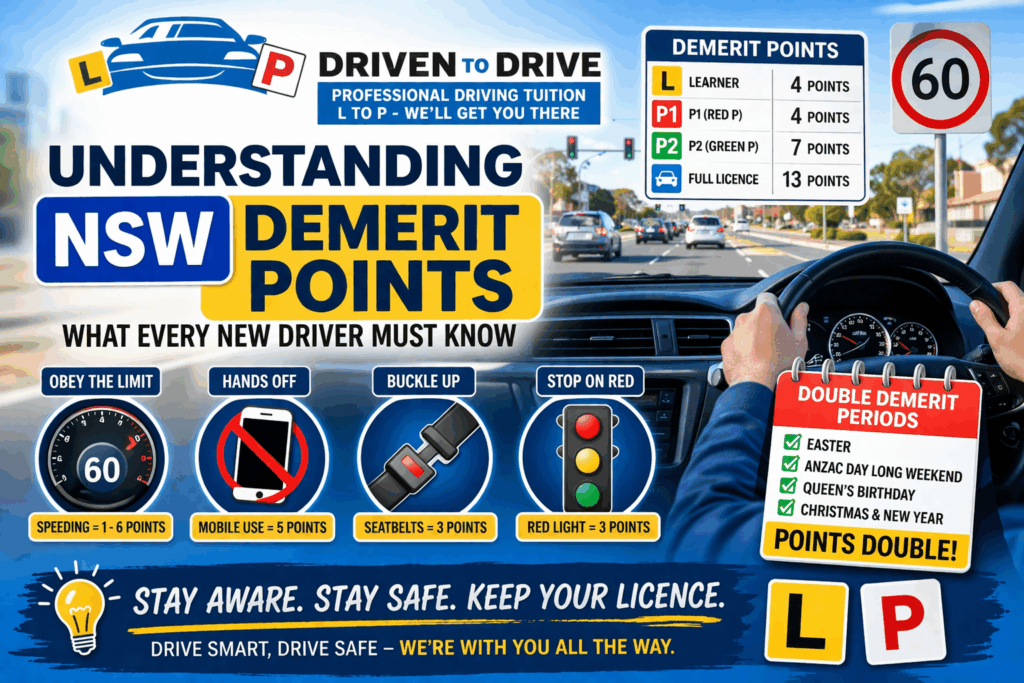
| ⚠️ Demerit Points Reminder for P1 Drivers
As a P1 driver, you hold only 4 demerit points. Exceeding this threshold results in a minimum 3-month licence suspension. Penalties vary by offence and severity. Always refer to Service NSW (service.nsw.gov.au) for the most current information on fines, demerit points, and suspension rules. |
Official Government Resources
📋 Official Government Resources
|
| Ready to Build Your Confidence Behind the Wheel?
The first solo drive is a mental milestone as much as a practical one — and preparation is everything. At Driven to Drive, we have helped hundreds of Sydney learners transition from L plates to P plates with calm, expert-guided instruction across Mascot, Botany, Rosebery, Eastlakes, Maroubra, Randwick, Bondi, and the South Eastern Suburbs. Whether you are still logging hours, preparing for your driving test, or looking for P-plate coaching after you have passed — Andrew and the Driven to Drive team are here to help you drive safely for life. 📞 0416 321 572 📧 driventodrive@outlook.com 🌐 driventodrive.com.au Book your lesson today — and let’s make every drive a confident one. |
Also in this series: Driving Test Day Preparation | Understanding Driver Fatigue | How to Handle Road Rage
| Disclaimer: This blog provides general driving information only. Always refer to official NSW Government sources for the latest road rules, penalties, and licensing requirements. Driven to Drive recommends consulting Service NSW (service.nsw.gov.au) and Transport for NSW (transport.nsw.gov.au) directly for all current licence conditions. |