
A trip to the beach, a camping weekend, or even helping a mate move house often involves towing a trailer. But for learner drivers and new P-platers across Sydney’s South Eastern Suburbs — from Mascot to Maroubra — towing introduces a completely different level of responsibility.
Towing is considered a higher-risk driving activity because it affects braking, steering, visibility, and overall vehicle control. For inexperienced drivers, even a small trailer can significantly change how a car behaves.
At Driven to Drive Driving School, Andrew brings over 11 years of experience helping learners safely progress from Ls to Ps. As a certified Safer Drivers Course facilitator, he focuses on building real-world awareness — including how to handle more advanced situations like towing.
In this guide, we’ll cover:
- What learner and P-plate drivers are legally allowed to do in NSW
- Key towing rules and requirements
- How towing affects your driving
- Practical safety techniques to build confidence
Can Learner and P-Plate Drivers Tow in NSW?
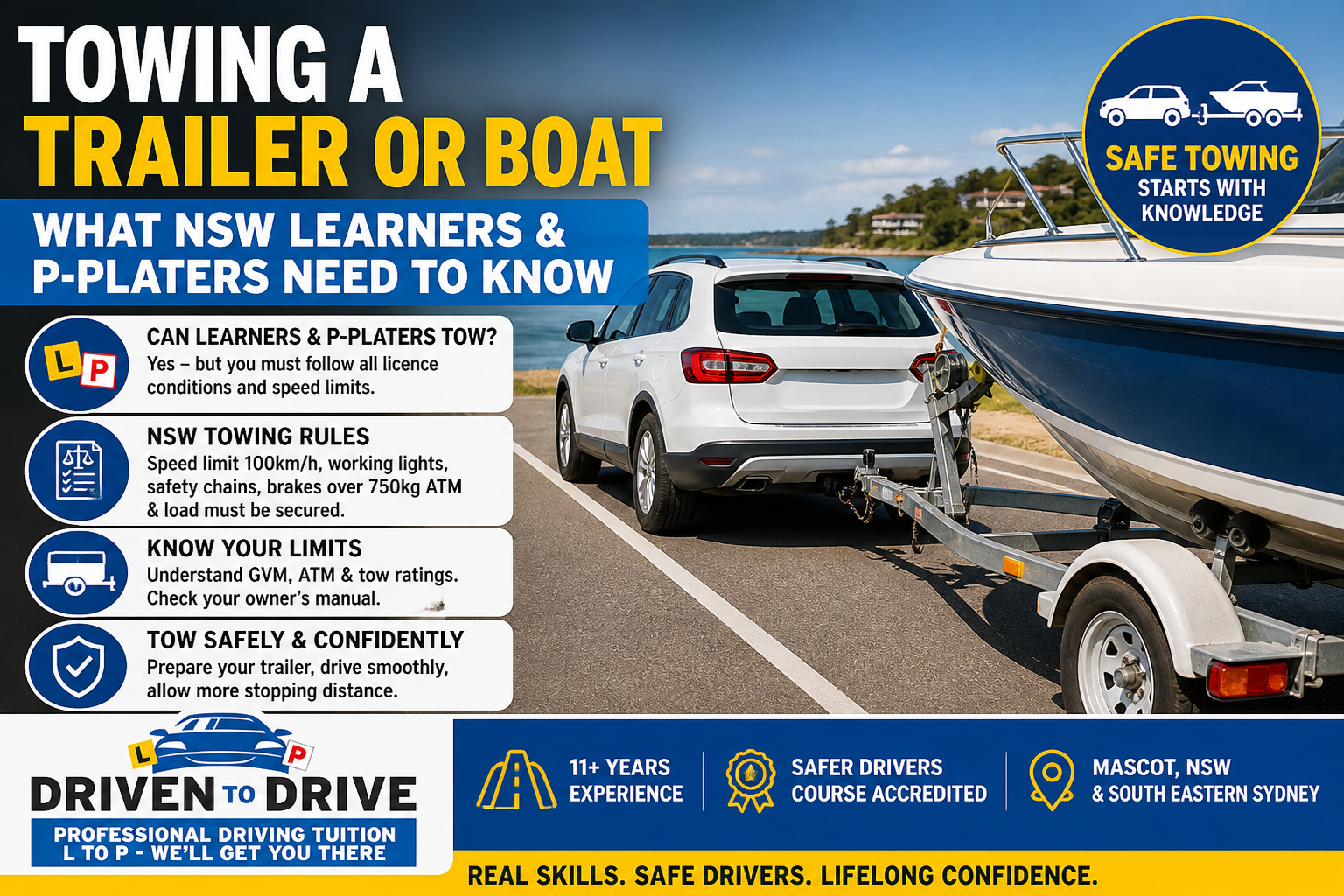
According to Transport for NSW and the Road User Handbook (latest edition):
- Learner drivers (L plates):
✔ Allowed to tow
✔ Must have a supervising driver
✔ Must follow all learner restrictions (including speed limits) - P1 drivers (red P plates):
✔ Allowed to tow
✔ Must follow standard P1 restrictions (e.g. speed limits, passenger rules) - P2 drivers (green P plates):
✔ Allowed to tow
✔ Must comply with standard P2 conditions
Important:
Being legally allowed to tow does not mean your vehicle is capable of doing so safely.
👉 Always check your vehicle’s:
- Tow rating (maximum towing capacity)
- GVM (Gross Vehicle Mass)
- Owner’s manual specifications
NSW Towing Laws You Must Know
The following rules are based on NSW Government guidance:
- Maximum speed when towing:
100 km/h or the posted speed limit (whichever is lower) - Trailer lights must work:
Brake lights, indicators, and tail lights must be fully functional - Safety chains:
Required for trailers over a certain size/weight - Braking systems:
Trailers over 750kg ATM (Aggregate Trailer Mass) must have their own braking system - Securing loads:
All loads must be properly restrained — unsecured loads are a serious safety risk - Licence class:
A standard Class C licence allows towing up to 9,000kg GCM (Gross Combination Mass)
Understanding Your Vehicle’s Towing Capacity
Before towing anything, you need to understand a few key terms:
- GVM (Gross Vehicle Mass):
The maximum weight your vehicle can carry (including passengers and cargo) - ATM (Aggregate Trailer Mass):
The total weight of the trailer when fully loaded - Tow Ball Download:
The downward force the trailer places on your vehicle’s tow ball
Why This Matters
Exceeding these limits can:
- Increase stopping distance
- Reduce steering control
- Cause mechanical damage
- Lead to unsafe driving conditions
Important:
Small cars and hatchbacks are often not suitable for towing boats or heavy trailers.
Always check:
- Your owner’s manual
- Manufacturer’s website
How Towing Changes the Way Your Car Handles
Towing affects nearly every aspect of driving.
1. Increased Stopping Distance
Your car is heavier — braking takes longer.
👉 Leave significantly more space between you and the vehicle ahead.
2. Trailer Sway
Caused by:
- High speeds
- Poor weight distribution
- Wind or passing trucks
Correction technique:
- Ease off the accelerator
- Keep steering steady
- Avoid sudden braking
3. Wider Turning Radius
The trailer “cuts corners.”
👉 Take wider turns to avoid kerbs or clipping objects.
4. Reversing with a Trailer
The biggest challenge for beginners.
Key principle:
- Turn the steering wheel opposite to the direction you want the trailer to go
5. Wind Effects
Trailers are affected by:
- Crosswinds
- Air pressure from large vehicles
👉 Stay steady and avoid sudden movements.
Preparing Your Trailer Before You Drive
Before every trip, follow this checklist:
- Check all lights are working (have someone confirm)
- Ensure the hitch is securely locked
- Attach safety chains correctly
- Check trailer tyre pressure
- Distribute weight properly (heavier items forward of axle)
- Secure all items with straps
Nothing should move or shift during transit.
Real-World Driving Scenarios (Sydney-Based)
Scenario 1: Merging onto Southern Cross Drive (Mascot)
Situation: You’re merging with a trailer into fast-moving traffic.
NSW Rule: Drivers must give way when merging and adjust speed safely.
Safe Approach:
- Build speed early
- Allow extra space
- Indicate clearly
- Merge smoothly — no sudden movements
Scenario 2: Turning at a Busy Intersection in Randwick
Situation: You’re turning left with a trailer.
NSW Rule: Drivers must maintain lane discipline and avoid crossing into other lanes.
Safe Approach:
- Position slightly wider before turning
- Check mirrors constantly
- Turn gradually to avoid trailer clipping kerb
Scenario 3: Reversing a Trailer in a Quiet Carpark (Botany)
Situation: Practising reversing before heading into a tight space.
NSW Principle: Maintain full control of the vehicle at all times.
Safe Approach:
- Use very slow speed
- Make small steering adjustments
- Stop and reset if needed
- Don’t rush
Scenario 4: Driving in Crosswinds near Coastal Roads (Maroubra)
Situation: Strong wind affects trailer stability.
Safe Approach:
- Reduce speed
- Keep steering steady
- Avoid sudden braking
- Maintain firm control
Common Mistakes & How to Avoid Them
- Overloading the trailer
→ Always stay within weight limits - Incorrect weight distribution
→ Keep heavier items toward the front - Driving too fast
→ Stick to safe towing speeds - Not allowing enough stopping distance
→ Increase following distance significantly - Overcorrecting during sway
→ Stay calm and ease off acceleration
The Safer Drivers Course (NSW)
The Safer Drivers Course, supported by the NSW Government, helps learners build advanced driving awareness.
What You Gain
- 20 logbook hours toward your 120-hour requirement
- Improved hazard perception and risk awareness
- Better decision-making under pressure
- Stronger defensive driving skills
Andrew at Driven to Drive is a certified facilitator, delivering the course in a calm, structured environment — ideal for learners preparing for real-world driving challenges like towing.
Penalties & Demerit Points (NSW)
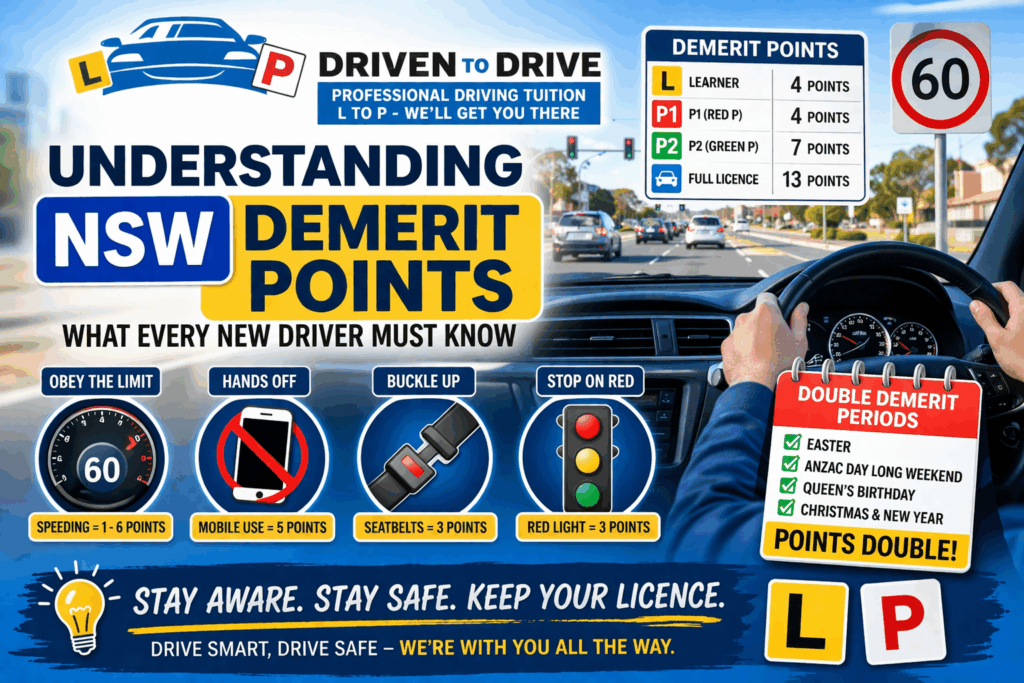
- Learner drivers have 4 demerit points only
- Exceeding this results in a minimum 3-month suspension
- Offences like unsafe loads or negligent driving can still apply when towing
Always refer to Service NSW for the most current rules and penalties.
Expert Tips from Driven to Drive
- Start in a quiet area before towing in traffic
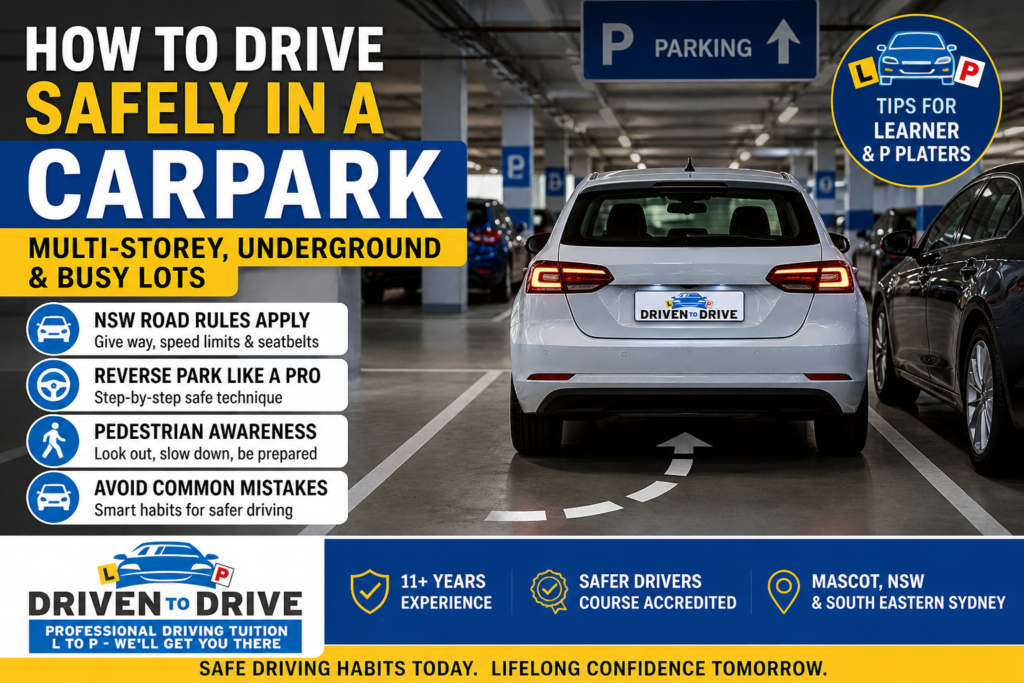
- Practise reversing in an empty carpark first
- Plan turns and merges well in advance
- Stay calm — smooth driving is safe driving
- If unsure, take a professional lesson before towing on busy roads
Government References
- Transport for NSW – Learner Driver Resources
- Service NSW – Getting Your Licence
- NSW Road User Handbook (latest edition)
- NSW Centre for Road Safety
- Safer Drivers Course (NSW Government)
Conclusion
Towing a trailer or boat in NSW is legal for learner and P-plate drivers — but it comes with added responsibility. It changes how your car accelerates, brakes, and turns, and requires a higher level of awareness and control.
The key is preparation, patience, and practice.
Start small, build your confidence gradually, and never rush into complex towing situations without experience.
Ready to build real driving confidence?
Book your lessons with Driven to Drive Driving School — South Eastern Sydney’s trusted driving school for over 11 years.
Or ask about incorporating towing awareness training into your lessons.
📞 0416 321 572
📧 driventodrive@outlook.com
🌐 https://driventodrive.com.au
Disclaimer: This blog provides general driving information only. Always refer to official NSW Government sources for the latest rules, penalties, and licensing requirements.