
Introduction
For learner drivers in Sydney’s South Eastern Suburbs — from Mascot and Botany to Maroubra, Randwick and Bondi — understanding road signs and markings is essential for safe, confident driving. The Road User Handbook (Transport for NSW) explains that road signs and markings are designed to regulate traffic, warn drivers of hazards, and provide important information to keep everyone safe.
With hundreds of signs to learn, it’s common for learners and parents to feel overwhelmed. At Driven to Drive Driving School, Andrew brings over 11 years of experience helping drivers-in-training build confidence step by step. As a certified Safer Drivers Course facilitator, he focuses on practical sign recognition, hazard awareness and calm decision-making — ensuring learners are fully prepared to transition from L plates to P plates safely and affordably.
Section 1: Sign Categories & Shapes (NSW Standards)
According to the Road User Handbook (Transport for NSW, current edition), signs in NSW are grouped by purpose and design.
1. Regulatory Signs
These signs tell you what you must or must not do.
- Often rectangular or circular.
- Red and black colours are common.
- Examples include speed limits, STOP, and GIVE WAY.
2. Warning Signs
- Typically triangular with a red border.
- Warn of upcoming hazards such as curves, intersections or pedestrian crossings.
3. Direction & Information Signs
- Usually rectangular.
- Provide guidance, distances and route information.
- Common on motorways and main roads.
4. Temporary Signs
- Orange or yellow background.
- Used for roadworks and changed traffic conditions.
Andrew teaches learners that shape and colour alone often provide the first clue about a sign’s meaning — an important skill during the NSW driving test.
Section 2: Essential Regulatory Signs
Speed Limit Signs
Speed limits must be obeyed at all times. The Road User Handbook states that drivers must not exceed the posted limit and must adjust speed to suit conditions.
In school zones, the limit is typically 40 km/h during signposted times (Transport for NSW – School Zones).
STOP Sign
A STOP sign requires drivers to:
- Come to a complete stop.
- Stop at the marked stop line, or before entering the intersection if no line exists.
- Give way to all vehicles and pedestrians.
Rolling stops are considered a breach of road rules.
GIVE WAY Sign
Drivers must:
- Slow down.
- Stop if necessary.
- Give way to vehicles in or entering the intersection.
No Entry / Do Not Enter
These signs prohibit vehicles from entering a road.
Lane Use Signs
Often displayed above lanes or at intersections, these signs show permitted movements (e.g., left turn only).
Example: In busy Mascot intersections near Botany Road, lane use signs determine whether a learner may proceed straight or must turn.
Section 3: Warning Signs You’ll See Daily
Warning signs prepare drivers for hazards ahead.
Common examples in Sydney include:
- Intersection ahead
- Pedestrian crossing ahead
- School zone warning
- Curve or bend warning
- Merging traffic
- Slippery when wet
The Road User Handbook emphasises adjusting speed and positioning when approaching warning signs.
Andrew teaches learners to:
- Identify the warning early.
- Check mirrors.
- Reduce speed smoothly.
- Prepare for the hazard.
Section 4: Road Markings Explained
Road markings are legally enforceable under NSW road rules and explained in the Road User Handbook.
White vs Yellow Lines
- White lines separate lanes moving in the same direction.
- Yellow lines separate opposing traffic.
Solid vs Broken Lines
- Broken lines may be crossed when safe.
- Single solid lines have restrictions.
- Double unbroken lines must not be crossed except in limited circumstances outlined in the handbook.
Stop & Give Way Lines
- A solid white line across a lane indicates where to stop.
- Broken lines indicate give way.
Turning Arrows
Indicate permitted direction of travel in that lane.
Bicycle Lane Markings
Drivers must not drive in a bicycle lane unless permitted (e.g., for short distances when entering or leaving a road, as outlined by NSW rules).
Section 5: Arrows & Special Markings
No Overtaking Lines
Double continuous centre lines mean overtaking is prohibited.
Clearway Markings
Clearways operate during specified times. Stopping in a clearway during operating hours is prohibited.
Bus Lane Markings
Only certain vehicles may use bus lanes (as defined by NSW road rules).
Keep Clear Zones
Marked with diagonal yellow lines. Drivers must not stop within these areas.
Andrew ensures learners understand that ignoring markings is treated the same as ignoring signs — both can result in penalties.
Section 6: Traffic Light Combinations
The Road User Handbook outlines standard traffic signal meanings:
- Red light: Stop.
- Yellow light: Stop if safe to do so.
- Green light: Proceed if safe.
Arrow Signals
Right-turn arrows indicate when turning traffic has priority.
Flashing Red
Used at railway crossings — drivers must stop.
Pedestrian Signals
Drivers must give way to pedestrians crossing legally at signalised crossings.
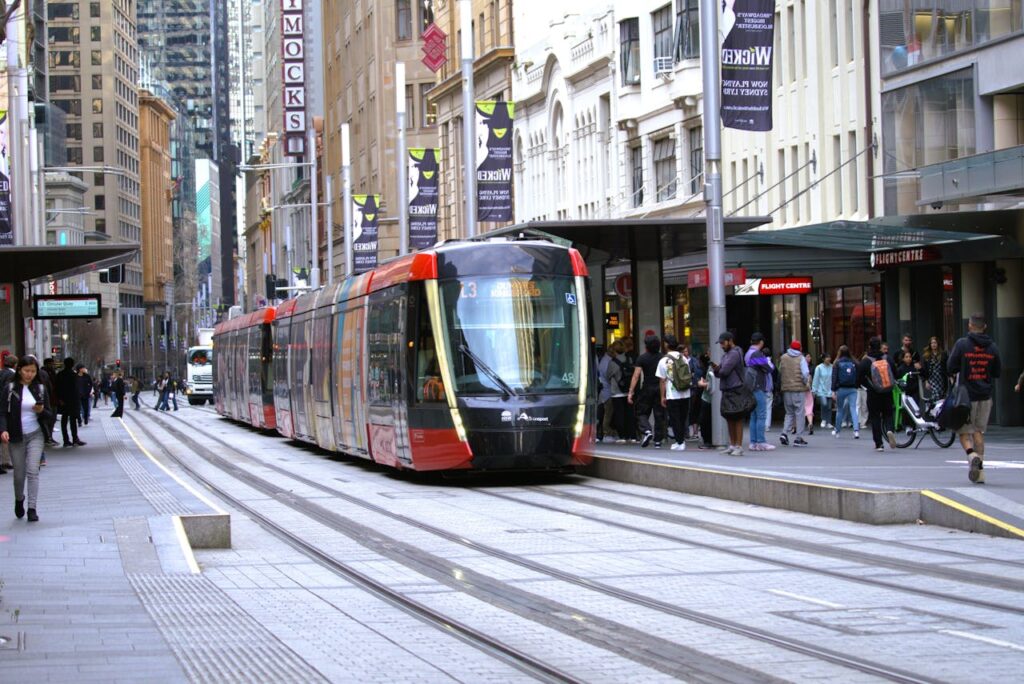
In areas like Randwick near light rail corridors, additional signals may apply.
Section 7: Signs Unique to Sydney’s Eastern Suburbs
Learners in Mascot and surrounding suburbs commonly encounter:
- Light rail signs (Randwick area).
- Clearway times on major roads like Anzac Parade.
- Beach parking restrictions in Bondi and Maroubra.
- Airport-related directional signage near Mascot.
Understanding these local variations improves test readiness and real-world safety.
Section 8: What to Do When You’re Unsure
Transport for NSW promotes defensive driving and hazard awareness.
If unsure:
- Slow down safely.
- Check mirrors.
- Observe other traffic carefully.
- Never guess or assume.
- Ask your instructor after the drive.
Andrew’s teaching philosophy focuses on calm decision-making rather than panic responses.
Common Learner Mistakes & How to Avoid Them
1. Ignoring lane arrows
Always check markings before entering an intersection.
2. Rolling through STOP signs
Come to a complete stop behind the line.
3. Not adjusting speed for warning signs
Reduce speed early and smoothly.
4. Driving in bus or bicycle lanes incorrectly
Understand permitted use under NSW rules.
5. Misreading clearway times
Check the sign carefully for operational hours.
The Safer Drivers Course (NSW)
The Safer Drivers Course (Transport for NSW) is designed for learners under 25 who have completed at least 50 logbook hours.
The course:
- Builds hazard perception and risk awareness.
- Encourages safe decision-making.
- Addresses distractions and peer pressure.
- Provides 20 hours credited toward the 120-hour requirement.
Andrew is a certified facilitator, delivering the course in a supportive and structured environment in Mascot. Many families find it strengthens both confidence and driving judgement before attempting the P1 test.
Demerit Points & Compliance
According to Service NSW:
- Learner drivers have a limit of 4 demerit points.
- Exceeding this results in a minimum three-month suspension.
Penalties vary depending on the offence and severity. Always refer to Service NSW for the latest updates.
Expert Instructor Tips from Driven to Drive
- Scan 12–15 seconds ahead to identify upcoming signs early.
- Practise recognising shapes and colours before reading full text.
- Plan lane changes early in busy areas like Maroubra Junction.
- Stay calm during peak-hour traffic in Mascot.
- Review each lesson to reinforce sign recognition skills.
Government References
- Transport for NSW – Learner Driver Resources
- Service NSW – Getting Your P1 Licence
- Road User Handbook (latest edition PDF)
- NSW Centre for Road Safety – Safer Drivers Course
(All factual content in this article is based on official NSW Government sources current as of 2025. Final publication should undergo human review by a qualified road safety professional.)
Conclusion
Road signs and markings are the language of the road. Mastering them is essential not just for passing the driving test, but for building lifelong safe driving habits.
With over 11 years of experience, a calm and structured teaching style, and accredited Safer Drivers Course delivery, Driven to Drive Driving School supports learners of all ages in Mascot and Sydney’s South Eastern Suburbs to move confidently from L plates to P plates.
Ready to become a safe, confident driver? Book your lessons with Driven to Drive — South Eastern Sydney’s trusted driving school for over 11 years.
📞 0416 321 572
🌐 https://driventodrive.com.au
Or join our Safer Drivers Course in Mascot and earn 20 logbook hours while learning the skills to drive safely for life.
Disclaimer: This blog provides general driving information only. Always refer to official NSW Government sources for the latest rules, penalties, and licensing requirements.