
Introduction
Cycling is a growing part of everyday transport across Sydney’s South Eastern Suburbs. From early-morning commuters riding along Anzac Parade to weekend cyclists near Bondi, Coogee, and Centennial Park, learner drivers are now sharing the road with more vulnerable road users than ever before.
For learner drivers — and the parents supervising them — understanding how to safely and legally interact with cyclists is an essential lifelong driving skill, not just something to memorise for the driving test. In New South Wales, cyclists are legally recognised road users with specific protections under the Road Rules.
At Driven to Drive Driving School, Andrew has spent over 11 years helping learners of all ages move confidently from Ls to Ps. With a strong focus on safety, affordability, and calm decision-making, Driven to Drive teaches learners how to share the road respectfully — including how to pass cyclists safely, navigate bike lanes, and manage pressure from other drivers.
This guide explains the current NSW road rules, common Eastern Suburbs scenarios, and practical techniques taught in lessons and the Safer Drivers Course, helping learners become safe, confident drivers for life.
Understanding NSW Cycling Laws
In NSW, drivers and cyclists must follow the same Road Rules, with additional protections recognising cyclists as vulnerable road users. These rules are outlined in the Road User Handbook and by Transport for NSW.
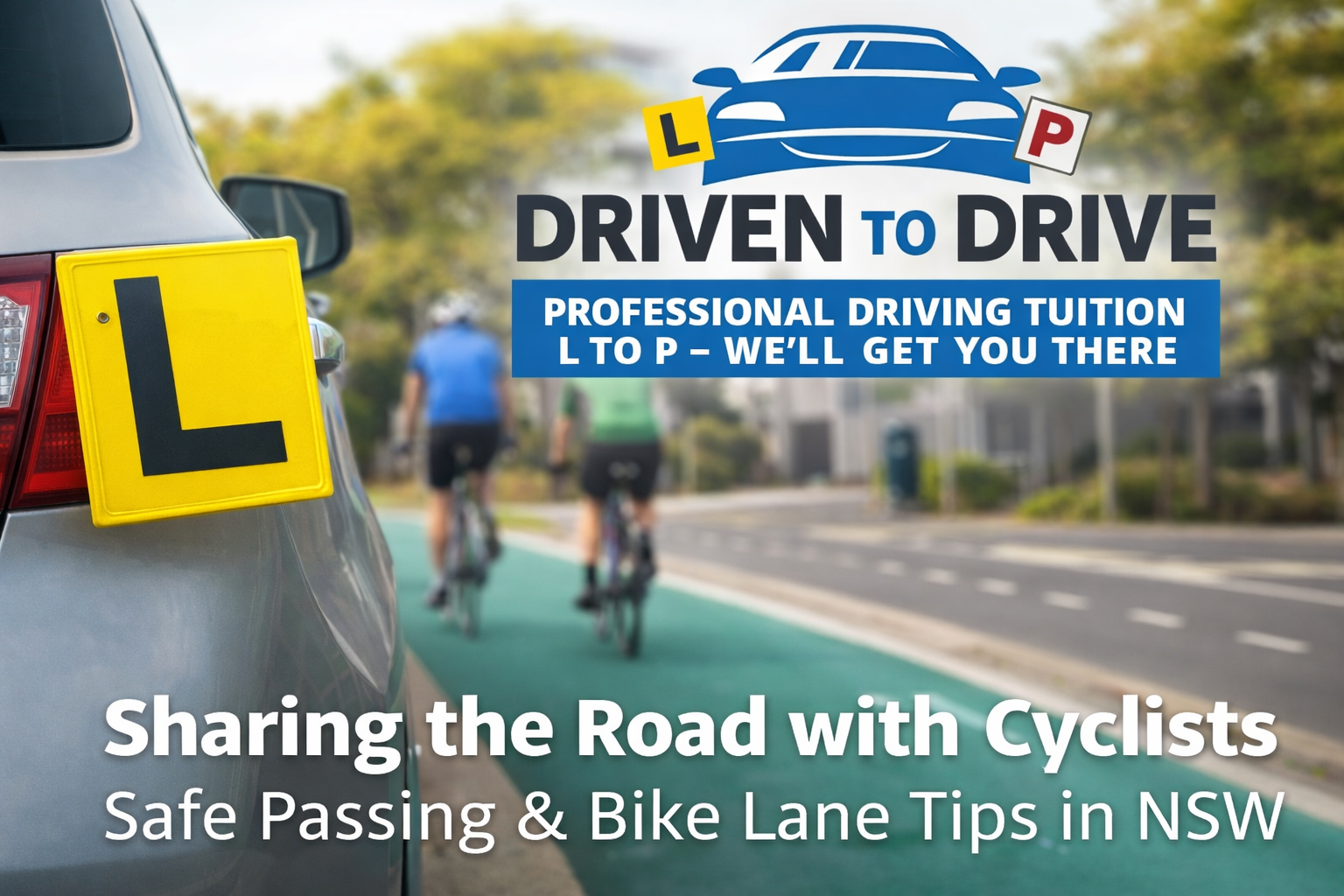
Minimum Passing Distance Rule
NSW law requires drivers to give cyclists:
- At least 1 metre when passing in speed zones 60 km/h or below
- At least 1.5 metres when passing in speed zones over 60 km/h
If necessary, drivers are allowed to cross centre lines or lane lines to maintain this distance, provided it is safe to do so and the driver has a clear view of oncoming traffic.
This rule is enforced to reduce sideswipe crashes and intimidation, particularly on narrow suburban roads.
Cyclists Using the Full Lane
Cyclists are legally allowed to:
- Ride two abreast (side by side)
- Use the full lane when it is unsafe to stay left, including narrow roads or approaching intersections
Learners must understand that cyclists are not required to “hug the kerb” if it compromises their safety.
Hook Turns and Intersections
At some intersections, cyclists may perform a hook turn, particularly where signs permit it. This involves a cyclist waiting on the left side of the road before completing a turn when traffic lights change.
Drivers must remain patient and give way where required.
Identifying Bike Lanes & Shared Paths
Eastern Sydney has a mix of cycling infrastructure, and learners must recognise the differences.
Dedicated Bike Lanes
- Marked by white bicycle symbols, often with green pavement
- Cars must not drive or park in these lanes during their hours of operation
Shared Lanes
- Display bicycle symbols without a full lane marking
- Indicate cyclists regularly use the lane, but cars may still use it
Separated Cycleways
- Physically separated from the road
- Vehicles must not enter these areas under any circumstances
Understanding lane markings is essential for avoiding penalties and ensuring cyclist safety.
Safe Passing Techniques Taught by Driven to Drive
Knowing when and how to pass a cyclist is a key skill developed during professional lessons.
When to Wait
- Narrow roads with no safe passing distance
- Blind crests or curves
- Approaching intersections or roundabouts
Waiting a few extra seconds is safer — and often faster — than forcing a risky pass.
How to Pass Safely
- Check mirrors
- Perform a head check to confirm blind spots are clear
- Adjust speed smoothly
- Move wide to maintain legal passing distance
- Return to lane gradually once fully clear
When passing groups of cyclists, learners are taught to treat them like a long vehicle — pass only when the entire group can be cleared safely.
Intersections & Roundabouts
Intersections are one of the highest-risk areas for cyclists.
Blind Spot Awareness
Cyclists may be hidden behind door pillars or mirrors. Learners must:
- Check mirrors early
- Perform head checks before turning or changing lanes
Roundabouts
Drivers must give way to cyclists already in the roundabout, just as they would to any other vehicle.
The “Dutch Reach”
When exiting a parked vehicle, drivers should open the door using the far hand, forcing the body to turn and check for cyclists — a habit encouraged in NSW road safety education.
High-Cycling Areas in Eastern Sydney
Learners driving in the Driven to Drive service area should expect regular cyclist activity in:
- Anzac Parade (commuter cycling route)
- Centennial Park surrounds
- Bondi, Coogee, and Maroubra beach roads
- Randwick and UNSW precincts
- Early-morning and weekend recreational routes
Andrew ensures learners practise these environments gradually, building confidence without pressure.
Anticipating Cyclist Behaviour
Cyclists may:
- Weave slightly at low speeds
- Move suddenly to avoid potholes or drains
- Signal turns with hand gestures
- Slow unexpectedly on hills
Learners are taught to maintain safe following distances and avoid assumptions about cyclist movements.
Dealing with Challenging Situations
Narrow Roads
If there isn’t room to pass legally, learners should slow down and wait patiently.
Rule-Breaking Cyclists
If a cyclist runs a red light or behaves unpredictably, learners must still drive defensively — anticipating risk rather than reacting emotionally.
Night-Time Cycling
Cyclists must use lights at night, but visibility can still be limited. Learners are trained to scan proactively, especially in poorly lit areas.
Common Mistakes Learners Make (and How to Avoid Them)
- Passing too closely → Always visualise the full 1–1.5 metre gap
- Forgetting head checks → Mirrors alone are not enough
- Rushing under pressure → Other drivers’ impatience should never dictate decisions
- Misreading bike lanes → Learn the markings early
The Safer Drivers Course: Building Lifelong Awareness
The NSW Safer Drivers Course is designed for learners under 25 who have completed at least 50 logbook hours.
The course:
- Focuses on hazard perception and risk awareness
- Teaches safe responses to distractions and peer pressure
- Encourages calm, decision-based driving
- Awards 20 bonus logbook hours toward the 120-hour requirement
At Driven to Drive, Andrew is a certified Safer Drivers Course facilitator, delivering the program in a structured, supportive environment that prioritises confidence over pressure.
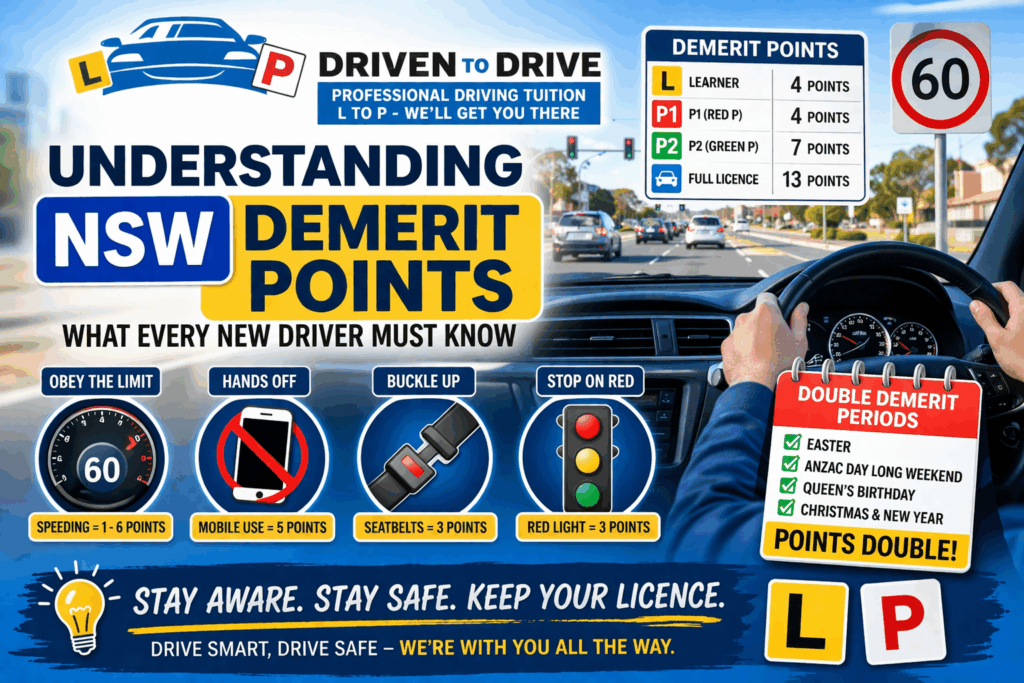
Penalties & Demerit Points (Learner Drivers)
Learner drivers in NSW have a limit of 4 demerit points.
Exceeding this limit results in:
- A minimum 3-month licence suspension
Penalties vary depending on the offence and circumstances. Always refer to Service NSW for the most current details.
Expert Tips from Driven to Drive
- Stay calm during peak-hour driving — patience reduces mistakes
- Check mirrors frequently, not just before manoeuvres
- Plan merges and turns early
- Maintain safe following distances at all times
- Treat test routes as normal driving — not a performance
Government References (NSW Official Sources)
- Transport for NSW – Learner Driver Resources
- Service NSW – Getting Your P1 Licence
- Road User Handbook (latest edition)
- NSW Centre for Road Safety
- Safer Drivers Course
Ready to Build Safe Driving Skills for Life?
Ready to become a safe, confident driver?
Book your lessons with Driven to Drive Driving School — proudly helping learners across Mascot and Sydney’s Eastern Suburbs transition from Ls to Ps for over 11 years.
📍 Mascot, NSW
📞 0416 321 572
🌐 https://driventodrive.com.au
✉️ driventodrive@outlook.com
Disclaimer: This blog provides general driving information only. Always refer to official NSW Government sources for the latest road rules, penalties, and licensing requirements.