

Dealing with Road Rage & Aggressive Drivers: Staying Safe on Sydney’s Busy Roads
A learner- and parent-focused guide by Driven to Drive Driving School, Mascot
Driving in Sydney’s South Eastern Suburbs — from Mascot and Botany to Randwick, Maroubra, and Bondi — exposes learners to a mix of busy intersections, peak-hour congestion, and impatient drivers. For new drivers, these environments can quickly feel overwhelming. Road rage, aggressive behaviour, and general driver frustration are common on metropolitan roads, and they can significantly impact a learner’s confidence.
At Driven to Drive Driving School, instructor Andrew has over 11 years of teaching experience, and as a certified Safer Drivers Course facilitator, he supports learners in building calm, predictable, and safe driving habits. We teach learners how to stay composed on the road, how to avoid conflict, and most importantly — how to uphold NSW’s road rules and safety principles, even in high-stress situations.
This blog explains what road rage looks like, how aggressive driving behaviour can affect learners, the official NSW rules that keep drivers safe, and the practical strategies we teach to help learners transition from Ls to Ps with confidence.
Understanding Aggressive Driving & Road Rage in NSW
Aggressive driving behaviours often include:
- Tailgating
- Excessive honking
- Unsafe overtaking
- Cutting off or merging without giving way
- Intimidation through close following
- Brake checking
- Yelling, swearing, or gesturing toward other drivers
The NSW Road User Handbook describes these behaviours as unsafe and illegal because they significantly increase the risk of a crash.
For learners, these moments can cause:
- Loss of confidence
- Hesitation at intersections
- Overcorrection
- Increased anxiety during lessons
- Difficulty focusing on hazard perception
Our teaching philosophy emphasises calm driving, predictable movements, and maintaining safe space around the vehicle — critical skills that help reduce the impact of other drivers’ aggressive behaviour.
Why Road Rage Happens in Sydney
According to the NSW Centre for Road Safety, aggressive behaviour often stems from:
► Traffic congestion and stress
Sydney’s arterial routes — including Southern Cross Drive, Anzac Parade, and the Eastern Distributor — are regularly congested, which increases driver frustration.
► Running late or impatience
Many aggressive manoeuvres occur because a driver is rushing or attempting to “beat traffic.”
► Misunderstandings between drivers
Small mistakes (e.g., hesitating at a roundabout) may trigger anger in impatient drivers.
► Targeting L- and P-plate drivers
Unfortunately, some drivers show frustration when they see L or P plates.
This makes it essential for learners to understand de-escalation and safe defensive habits.
Official NSW Road Rules Relevant to Handling Aggressive Drivers
Below are key rules from the NSW Road User Handbook and official Transport for NSW guidance:
1. Maintain a Safe Following Distance
The Road User Handbook states that drivers must allow at least a 3-second gap in good conditions.
Increasing this distance gives learners more time to respond when under pressure.
2. Avoid Sudden Braking
Sudden braking increases the risk of a rear-end collision, especially if being tailgated.
3. Keep Left Unless Overtaking (where applicable)
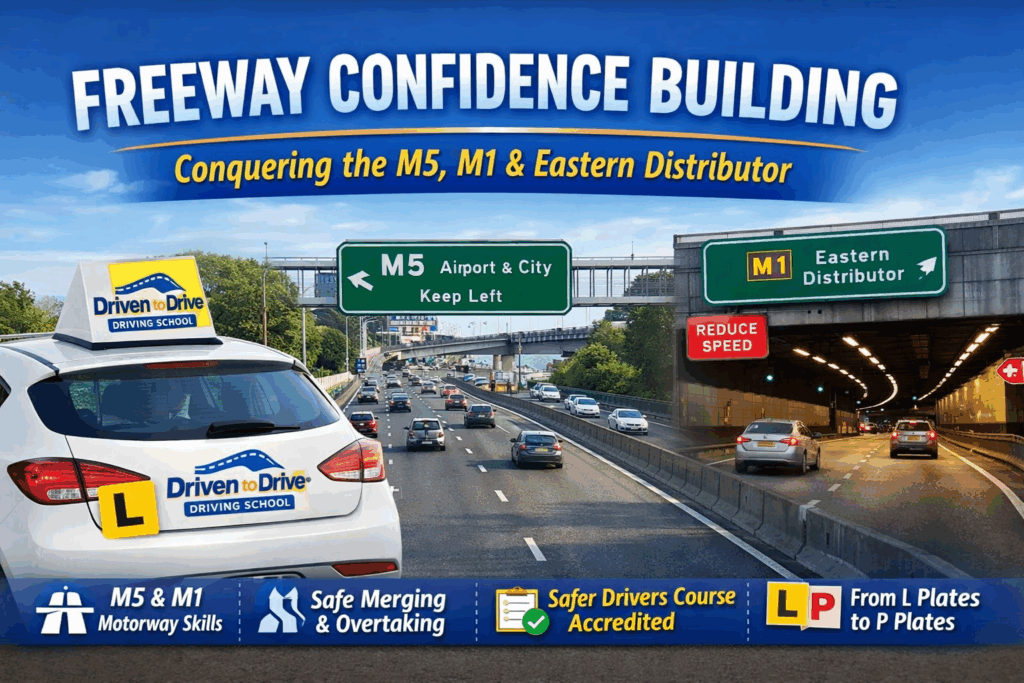
On multi-lane roads with keep-left signage, travelling in the left lane allows other drivers to pass safely.
4. Give Way Rules Must Always Be Followed
Aggressive behaviour from other drivers does not change the give-way rules in NSW.
Learners must follow road rules, even if pressured.
5. Never Stop or Get Out of the Vehicle on a Motorway
The Road User Handbook clearly warns that stopping on a motorway outside emergencies is dangerous and illegal.
These rules help learners stay safe even in the face of intimidating or unpredictable behaviour.
Realistic Scenarios Learners Face in South Eastern Sydney
Scenario 1: Being Tailgated on Bunnerong Road, Maroubra
The situation:
A learner travelling at the posted speed limit is tailgated by an impatient vehicle.
Relevant NSW rule:
Drivers must maintain a safe following distance; tailgating is unsafe and increases crash risk (Road User Handbook).
Driven to Drive method:
- Stay at the posted speed limit — do not speed up.
- Maintain a 3-second (or greater) gap from the vehicle ahead.
- Keep predictable lane position — avoid drifting.
- When safe, indicate early and move to the left lane or allow the vehicle to pass.
- Continue driving calmly without reacting emotionally.
Scenario 2: Aggressive Honking at Mascot’s Busy Intersections
The situation:
A learner waits at a right-turn bay on O’Riordan Street. The driver behind becomes impatient and honks aggressively.
Relevant NSW rule:
Horns must only be used to warn others of danger — not to express frustration.
Driven to Drive method:
- Focus on the intersection and follow right-turn give-way rules exactly as taught.
- Ignore honking; do not rush into the turn.
- Only turn when there is a safe gap, as required by NSW guidance.
- Maintain calm breathing and steady vehicle control.
Learners are reminded: Your job is to drive safely — not to satisfy impatient drivers.
Scenario 3: Dangerous Overtaking Near Randwick
The situation:
A vehicle attempts an unsafe overtake on a two-lane section near Alison Road.
Relevant NSW rule:
Overtaking must only be performed when the road markings, visibility, and conditions allow it (Road User Handbook).
Driven to Drive method:
- Hold your lane and maintain legal speed.
- Do not accelerate to “block” the overtake — remain predictable.
- Keep both hands on the wheel and prepare for sudden movements from the other driver.
- Create a safe buffer by slowing slightly (without braking heavily) once the vehicle has passed.
Scenario 4: Verbal Abuse or Gestures From Another Driver
The situation:
A learner attempts to merge onto Southern Cross Drive and a driver shouts or gestures at them.
Relevant NSW rule:
Drivers must not engage in behaviour that distracts or endangers others.
Driven to Drive method:
- Focus on your lane and gap selection.
- Avoid eye contact.
- Maintain speed, merge safely, and continue driving.
- If the aggressive behaviour continues, exit the motorway at the next safe exit.
Common Learner Driver Mistakes (and How to Avoid Them)
These are frequent learner errors we see on Sydney roads:
1. Rolling Stops at Stop Signs
According to the Road User Handbook, drivers must come to a complete stop.
We teach learners to pause fully, breathe, then check for hazards.
2. Not Checking Blind Spots
Shoulder checks are required before lane changes, merging, or pulling out.
3. Hesitating Too Long at Roundabouts
Indecision increases risk. We teach a structured, safe gap-selection technique.
4. Speeding Up Under Pressure
Learners must maintain legal speed limits, not react to other drivers’ impatience.
5. Reacting Emotionally to Aggression
Anger, frustration, or flustered decisions can lead to mistakes.
Our lessons prioritise emotional control and calm driving habits.
De-Escalation Strategies: Practical, Safe, NSW-Aligned
If another driver displays aggressive behaviour, the safest actions include:
- Never engage, yell, or gesture back.
- Avoid eye contact.
- Let the other driver pass when it is safe.
- Change lanes early if pressured from behind.
- Slow slightly (not abruptly) to create a safe buffer.
- If threatened, drive to a public, well-lit location — never stop in isolation.
If a driver is physically threatening or following you:
- Drive to a police station if possible.
- If immediate danger is present, call 000.
- Keep doors locked and windows closed.
- Only exit the vehicle in a safe public area.
Defensive Driving Techniques Every Learner Should Practise
These strategies match NSW risk-management principles taught in the Safer Drivers Course:
1. Maintain a Minimum 3-Second Following Distance
Increases reaction time and reduces stress under pressure.
2. Use Indicators Early
Predictable driving reduces misunderstandings and conflict.
3. Choose Lanes That Match Your Speed & Confidence Level
Left lanes are generally safest for learners on multi-lane roads.
4. Avoid Sudden Braking or Lane Changes
Smooth driving supports hazard perception and calm decision-making.
5. Keep a Safe Escape Path
This may include staying slightly to the left of your lane or maintaining extra space ahead.
NSW Safer Drivers Course: Building Confidence & Emotional Control
The NSW Safer Drivers Course, delivered through accredited providers, helps learners:
- Strengthen hazard perception
- Manage peer pressure and distractions
- Anticipate and respond to high-risk situations
- Develop safer night-driving and motorway habits
- Earn 20 logbook hours toward the required 120 hours
As a certified Safer Drivers Course facilitator, Andrew creates a calm and supportive environment where learners practise real-world risk management — including how to stay composed around aggressive drivers.
NSW Penalties & Demerit Points (Official Guidance)
From Service NSW:
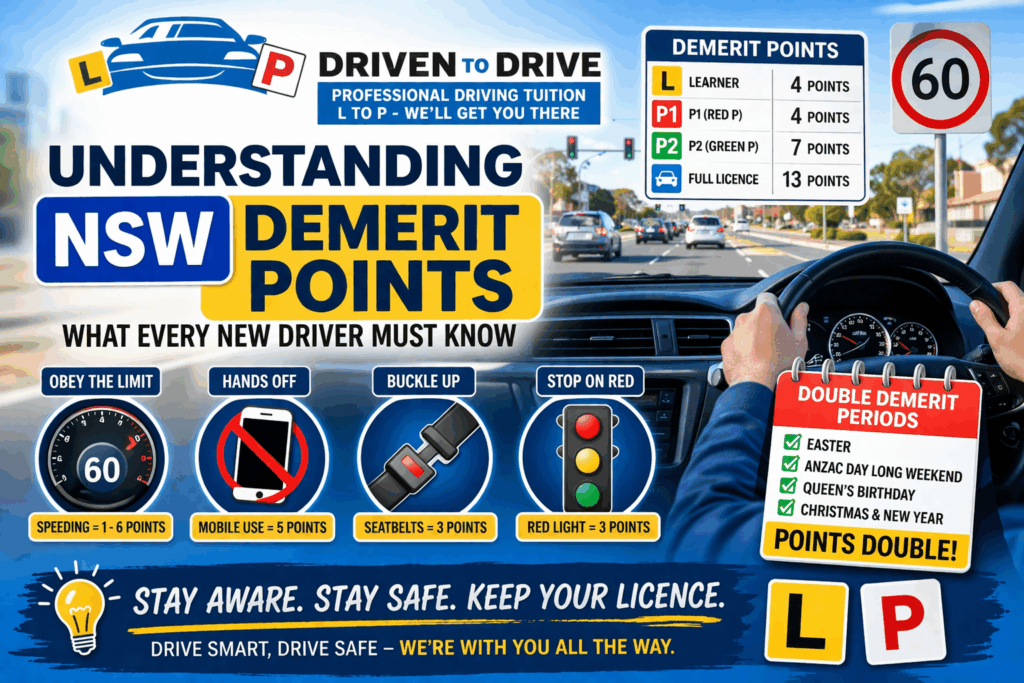
- Learners have 4 demerit points.
- Exceeding this results in a minimum 3-month suspension.
- Penalties vary depending on the offence and severity.
Aggressive behaviour or reacting unsafely under pressure can lead to offences affecting a learner’s licence status. That’s why building emotional control and defensive driving skills early is essential.
Instructor-Backed Expert Tips for Staying Calm on the Road
1. Breathe and Pause
A single deep breath can reset decision-making and focus.
2. Focus on Your Path, Not the Driver Behind
Your responsibility is forward hazard management.
3. Anticipate Risk Early
Look ahead for lane merges, congestion, or likely aggressive behaviour.
4. Practise Motorway and Peak-Hour Driving
Instructor-supervised exposure builds genuine confidence.
5. Approach Every Drive With a Calm Mindset
Calm drivers make better decisions, even in stressful moments.
Government References (Official NSW Sources)
- Transport for NSW – Learner Driver Resources
- Service NSW – Getting Your P1 Licence
- NSW Road User Handbook (latest edition)
- NSW Centre for Road Safety – Safer Drivers Course
Ready to Become a Safe, Confident Driver?
Driven to Drive Driving School has supported learners in Mascot and the South Eastern Suburbs for over 11 years, helping them move from Ls to Ps with confidence, calmness, and lifelong safe-driving habits.
📞 0416 321 572
📧 driventodrive@outlook.com
🌐 https://driventodrive.com.au
Join our Safer Drivers Course in Mascot and earn 20 logbook hours while learning the skills to drive safely for life.
Disclaimer
This blog provides general driving information only. Always refer to official NSW Government sources for the latest rules, penalties, and licensing requirements.